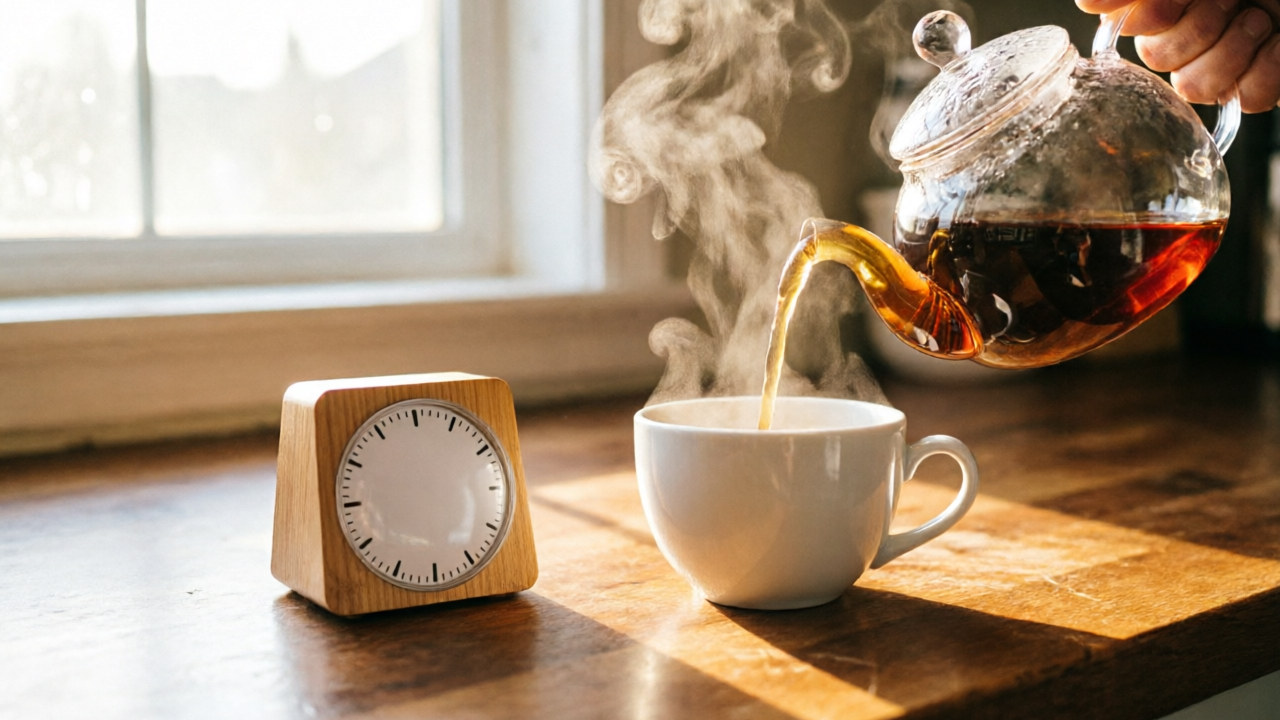
I have been brewing tea for years, and most steeping guides say “green 1-3 minutes, black 3-5 minutes” and stop there. That chart works once - then you wonder why your oolong tastes flat at 3 minutes but bitter at 5, or why the same green tea needs 60 seconds one day and 90 the next. Steep time isn’t a fixed number. It’s a conversation between oxidation level, water temperature, and how much leaf you packed in. Here’s why the numbers change, a chart you can screenshot, and a way to find your own edge.
Why Steeping Time Changes by Tea Type
Every tea comes from Camellia sinensis - white, green, oolong, black, and pu-erh all start as the same leaf. What changes is oxidation: how much the leaf’s enzymes have been allowed to convert polyphenols before drying [1].
Green and white tea are unoxidized. Their cell walls stay intact, so when hot water penetrates, bitter polyphenols extract fast. Leave green tea in water for 5 minutes and you’ll taste harsh tannins that black tea would never develop at the same time - because black tea’s oxidation has already converted those tannins into theaflavins and thearubigins, which are smoother on the palate [1].
Black tea tolerates longer steeps because its tannins have been pre-converted during full oxidation. You can push black tea to 5 minutes without the cup turning harsh. That’s why English Breakfast and Assam taste balanced at 4 minutes, not thin or bitter.
Oolong sits in the middle - semi-oxidized, it can go short (gongfu, 15-30 seconds) or long (Western, 3-5 minutes) depending on your style. Lighter oolongs like Tieguanyin extract faster than roasted Dancong.
Pu-erh is fermented and aged. The first steep is often a quick rinse (5 seconds, discarded) to wake the compressed leaf. After that, short steeps of 10-20 seconds in gongfu style, or 3-5 minutes Western, draw out earthy depth without bitterness.
Herbal tisanes (chamomile, peppermint, rooibos) aren’t Camellia sinensis at all. They have no tannin ceiling - you can steep them 5-7 minutes or longer without bitterness, and many actually need the extra time to release their flavor compounds [2].
Want to taste these differences side by side? An 8-flavor sampler set spanning black, green, oolong, and herbal lets you run the same 3-minute steep across different leaf types and taste exactly where each one tips.
The Steep-Time Chart
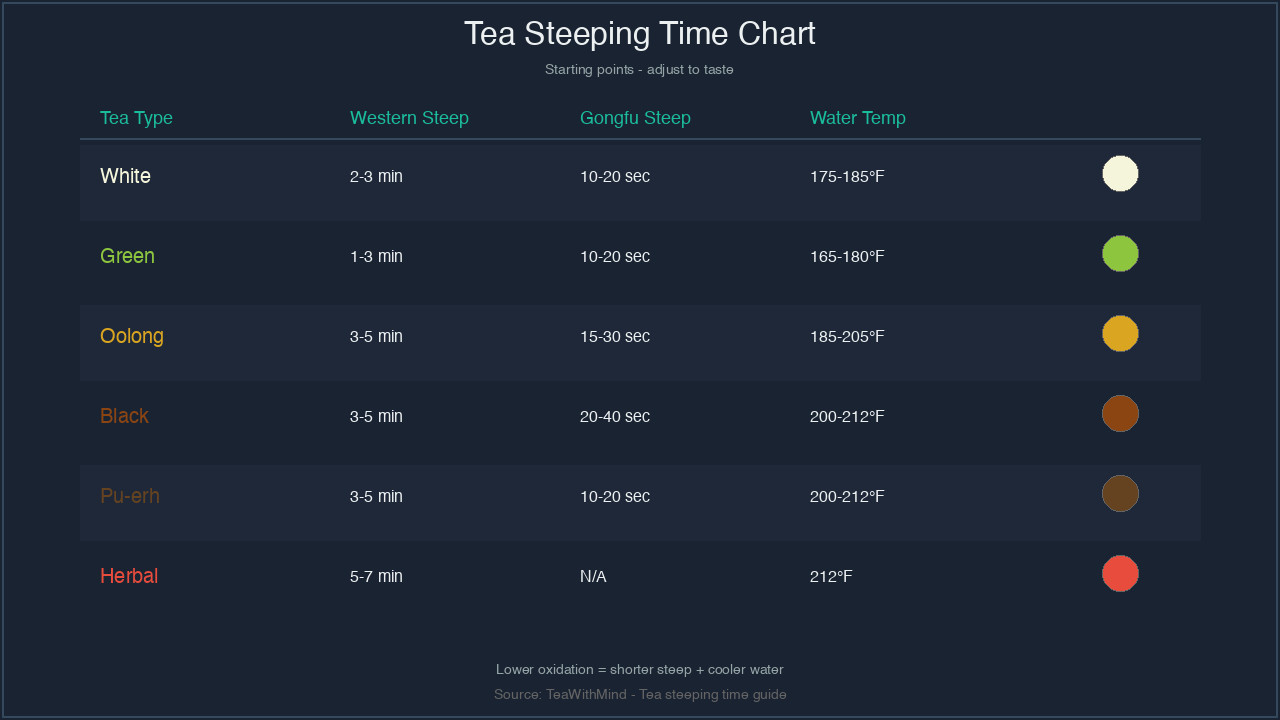
Bookmark this chart or screenshot it for your kitchen. These are starting points, not rules - your tongue adjusts the final number.
| Tea type | Western steep | Gongfu steep | Water temp |
|---|---|---|---|
| White | 2-3 min | 10-20 sec | 175-185°F (80-85°C) |
| Green | 1-3 min | 10-20 sec | 165-180°F (74-82°C) |
| Oolong | 3-5 min | 15-30 sec | 185-205°F (85-96°C) |
| Black | 3-5 min | 20-40 sec | 200-212°F (93-100°C) |
| Pu-erh | 3-5 min | 10-20 sec | 200-212°F (93-100°C) |
| Herbal / Tisane | 5-7 min | N/A | 212°F (100°C) |
Notice the pattern: lower oxidation = shorter steep + cooler water. Green and white tea share the same tight window because both are unoxidized. Black and pu-erh share the hot-water end because oxidation and fermentation have already tamed the bitter compounds [1].
Timing precision matters more than people think. A magnetic digital kitchen timer on your fridge means you’re not guessing “has it been 2 minutes or 4?” The difference between a good green tea and a bitter one is often 30 seconds.
Western vs Gongfu Steeping
Two brewing rhythms produce completely different cups from the same leaf.
Western style uses less leaf, more water, and longer time - typically 2g of leaf per 240ml, steeped 3-5 minutes. You get one solid cup per steep, and maybe a second weaker one. This is how most people brew at home: teapot or mug, a few minutes, done.
Gongfu style flips the ratio: more leaf, less water, shorter time. A 100ml gaiwan with 5g of leaf, steeped for 10-40 seconds, repeated 6-10 times. Each pour captures a different layer - the first is aromatic, the middle pours carry body, and the later steeps reveal sweetness [4].
Why does gongfu work with such short times? Because the high leaf-to-water ratio means extraction is concentrated. You’re tasting the front of the extraction curve - the volatile aromatics and lighter compounds - before the heavier tannins kick in. As steeps progress, you add 5-10 seconds each round to track the shifting flavor [4].
For the Western path, a HIWARE glass teapot with removable infuser lets you see the liquor color develop and pull the infuser at the exact moment. For gongfu, a Cosori gooseneck temperature-control kettle gives you the precise heat and pour control that short steeps demand.
For a deeper comparison of the two methods, see the live gongfu vs Western brewing guide. If you’re new to short steeping, the gongfu basics technique guide walks through the setup step by step.
Signs of Over-Steeping and Under-Steeping
Your tongue tells you faster than any chart. Here’s what to look for:
Over-steeped tea tastes bitter, astringent, and sometimes cloudy. The bitterness sits on the back of your tongue and lingers. Chemically, what’s happening is that polyphenols and catechins have dissolved past the flavor threshold - the same compounds that give tea its body in small amounts overwhelm the cup when over-extracted [1]. Green tea hits this wall fast: 3 minutes is often the edge. Black tea is more forgiving, handling 5-6 minutes before going harsh.
Under-steeped tea tastes thin, weak, and aroma-less. The liquor may look pale, and the flavor disappears mid-sip. This happens when extraction stopped before the heavier, slower-dissolving compounds had time to release. White tea is the most common victim - people pull it at 1 minute because the chart says “2-3” and they’re nervous about bitterness, but white tea needs the full 3 minutes to show its honeyed depth.
The 30-Second Test
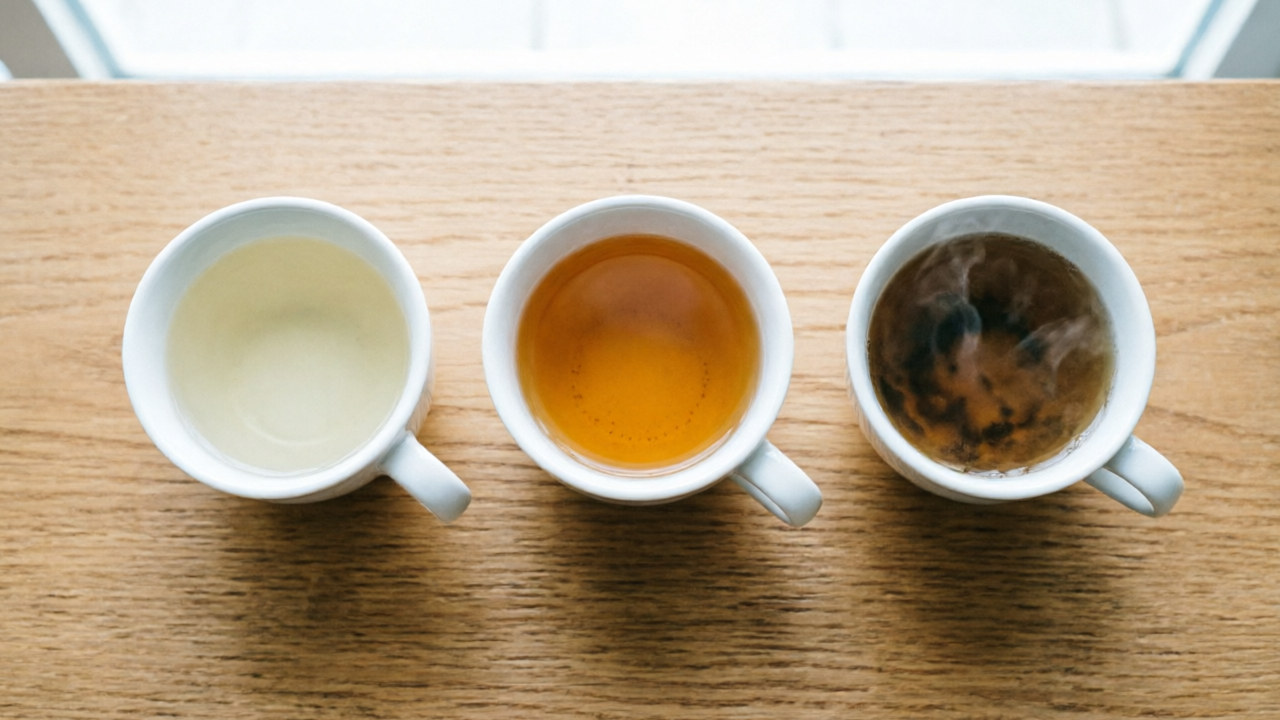
Here’s how to find your personal edge: brew at the chart’s recommended time, pour half the cup, then let the remaining leaf steep 30 seconds more and pour the second half. Taste both. The difference tells you exactly where your palate sits.
If the second pour is better, add 30 seconds to your standard time. If it’s bitter, you’ve found your ceiling. This works because extraction isn’t linear - it accelerates. The gap between “good” and “bitter” is often a single 30-second window.
The tool that makes this test work is fast leaf removal. A cramped tea ball traps leaves and keeps extracting even after you lift it out. An extra-fine mesh basket infuser lifts clean and stops extraction the moment you remove it. If your basket is too small for oolong or white tea leaves to expand, the OXO Brew infuser basket gives larger leaves the room they need.
For a systematic fix when something goes wrong, the bitter tea troubleshooter walks you through the three common causes and their solutions.
Adjusting for Personal Taste
Once you’ve run the 30-second test, adjusting is straightforward:
Stronger cup? Add leaf, not time. More leaf at the same steep duration gives you a fuller cup without the bitterness that comes from extending extraction. This is the most useful tip on this page - people reach for “steep it longer” when the answer is “use more leaf.”
Weaker cup? Use less leaf or shorten the steep by 30-60 seconds. Don’t dilute with more water after brewing - that washes out flavor, not just strength.
More caffeine? Steeping 1-2 minutes longer does extract more caffeine, but with diminishing returns. Most caffeine comes out in the first 1-2 minutes; pushing to 5 minutes adds only 20-30% more while also pulling bitter compounds [3]. If you want a stronger caffeine hit without the bitterness, use more leaf at the same time. For the actual numbers, see caffeine content by tea type.
Temperature and time are coupled. Hotter water extracts faster - so green tea at 185°F needs a shorter steep than green tea at 175°F. A Chefman temperature-control kettle with presets for each tea type takes the guesswork out of both variables at once.
The interactive steeping time calculator lets you plug in tea type, vessel size, and leaf amount to get a personalized starting point.
Common Steeping Mistakes
-
Steeping all teas at boiling water. Boiling water scorches green and white tea instantly, extracting bitter polyphenols before flavor compounds even release. Green tea wants 165-180°F; only black, pu-erh, and herbal should see 212°F [1]. Fix: a temperature-control kettle with presets.
-
Leaving leaves in the pot after pouring. The leaves keep extracting in residual water, turning your second cup bitter even though you “finished” the steep. Fix: use a teapot with a removable infuser and pull the basket when time’s up.
-
Using tea bags for gongfu. Tea bags contain fine-cut leaves (fannings) that extract everything in one steep - there’s no layering across multiple short pours. Gongfu needs whole leaf. Fix: use loose-leaf tea. A green tea sampler gives you four whole-leaf greens to practice with.
-
Ignoring water temperature. Time and temperature work together. Green tea at 180°F for 2 minutes tastes different from green tea at 170°F for 2 minutes - the hotter water extracts faster, so the same steep duration gives you more (and potentially bitter) compounds. Fix: control both variables.
-
Steeping to the same time every infusion. On second and third steeps, the leaf has already opened and extracts differently. For Western re-steeps, add 30-60 seconds. For gongfu, lengthen each pour by 5-10 seconds [4]. A mechanical kitchen timer is simple to reset between pours.
Practice makes these adjustments automatic. A reliable English Breakfast black tea tin is forgiving enough to test 3-minute vs 5-minute steeps without wrecking the cup - a good training leaf for mistake #5.
Where to Go Next
- Full brewing system: How to brew tea: the first cup system
- Leaf-to-water ratio: the ratio skill that pairs with steep time
- Method comparison: gongfu vs Western brewing
- By-leaf deep dives: green tea · black tea · oolong · white tea · pu-erh
- Interactive tool: steeping time calculator
- Brewing hub: all brewing guides
References
[1] Wikipedia contributors. “Tea.” Wikipedia. https://en.wikipedia.org/wiki/Tea#Chemical_composition
[2] Wikipedia contributors. “Steeping.” Wikipedia. https://en.wikipedia.org/wiki/Steeping
[3] TeaWithMind. “Caffeine by Tea Type.” TeaWithMind. https://teawithmind.com/wellness/caffeine-by-tea-type/
[4] Wikipedia contributors. “Gongfu tea.” Wikipedia. https://en.wikipedia.org/wiki/Gongfu_tea
The Mind of Steeping
Steeping time is not a timer - it is a conversation between leaf and water. Oxidation sets the vocabulary; temperature sets the volume. Start with the chart, taste at thirty-second intervals, and trust your palate over any number you find online. Your perfect cup lives where the chart ends and your tongue decides.