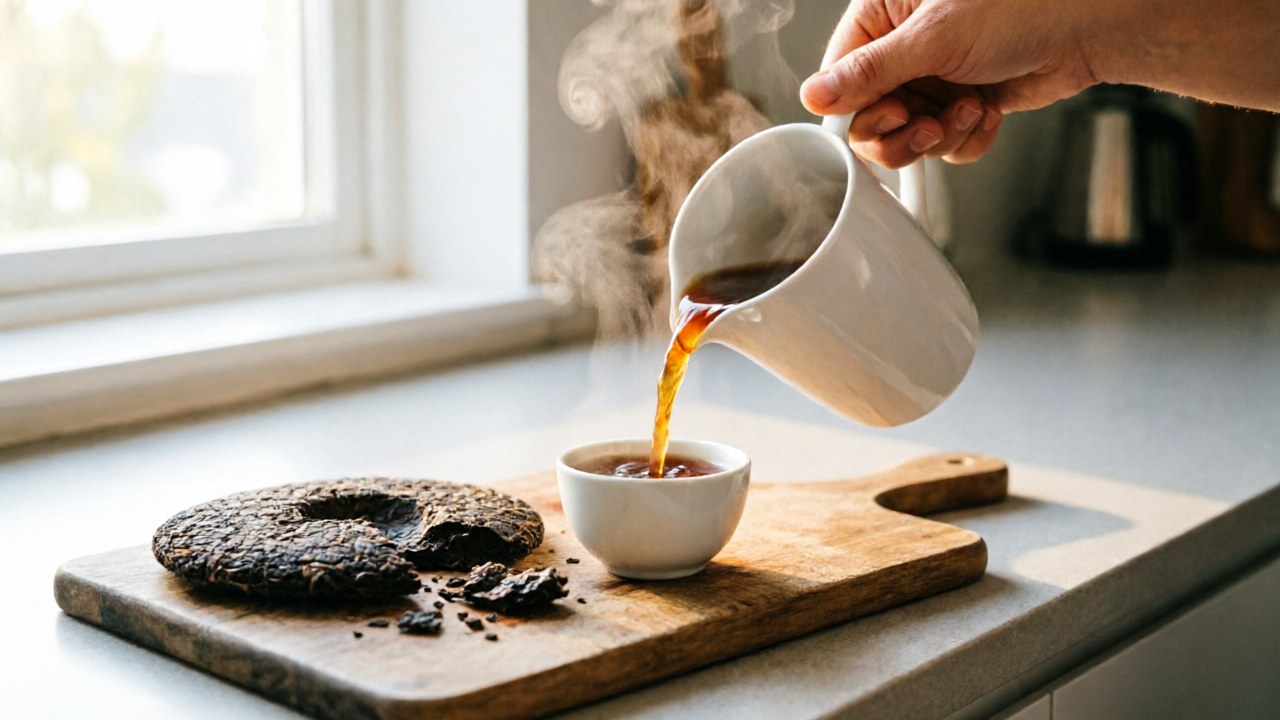
Puerh is not one tea but two: sheng (raw, alive, slowly aging) and shou (ripe, dark, already settled). Each asks for different water, different patience, and a rinse that wakes the compressed leaf. This is a hands-on brewing system, not a temperature chart.
Why Puerh Needs Its Own Brewing Classroom
Most tea arrives loose and ready to steep. Puerh arrives compressed - a dense disk of leaves pressed so tight that water alone can’t reach the inner layers. Before you brew, you break. Before you steep, you rinse. The process starts with a tea needle, not a kettle.
The split between sheng and shou drives every parameter that follows. Sheng (raw) puerh is sun-dried after kill-green (shaqing) and left to age naturally; its leaves stay closer to green tea in chemistry, which means boiling water scorches them into bitterness [1]. Shou (ripe) puerh undergoes wo dui - a 45-60 day wet-piling process invented in the 1970s at the Menghai Tea Factory, which accelerates fermentation, breaking down the leaf structure and creating the dark, earthy character [1]. Fermented leaves can take a full boil without turning bitter.
Most online guides give a generic “90-100°C for puerh” and move on. That works for shou. It ruins young sheng. The sheng/shou temperature split is the single most important decision in puerh brewing, and skipping it is the fastest way to a bad cup [4].
To taste the difference side by side, start with a TAETEA 7542 sheng cake, $23.99 and a SANRAN Aged Ripe shou cake, $28.99. The 7542 is the benchmark sheng blend from Menghai - the recipe that serious drinkers use to calibrate their palate. The SANRAN is a 2015 shou with five years of settling, which means the wo dui pile note has mellowed enough to show the tea’s real character [1].
Breaking the Cake - Tools and Technique
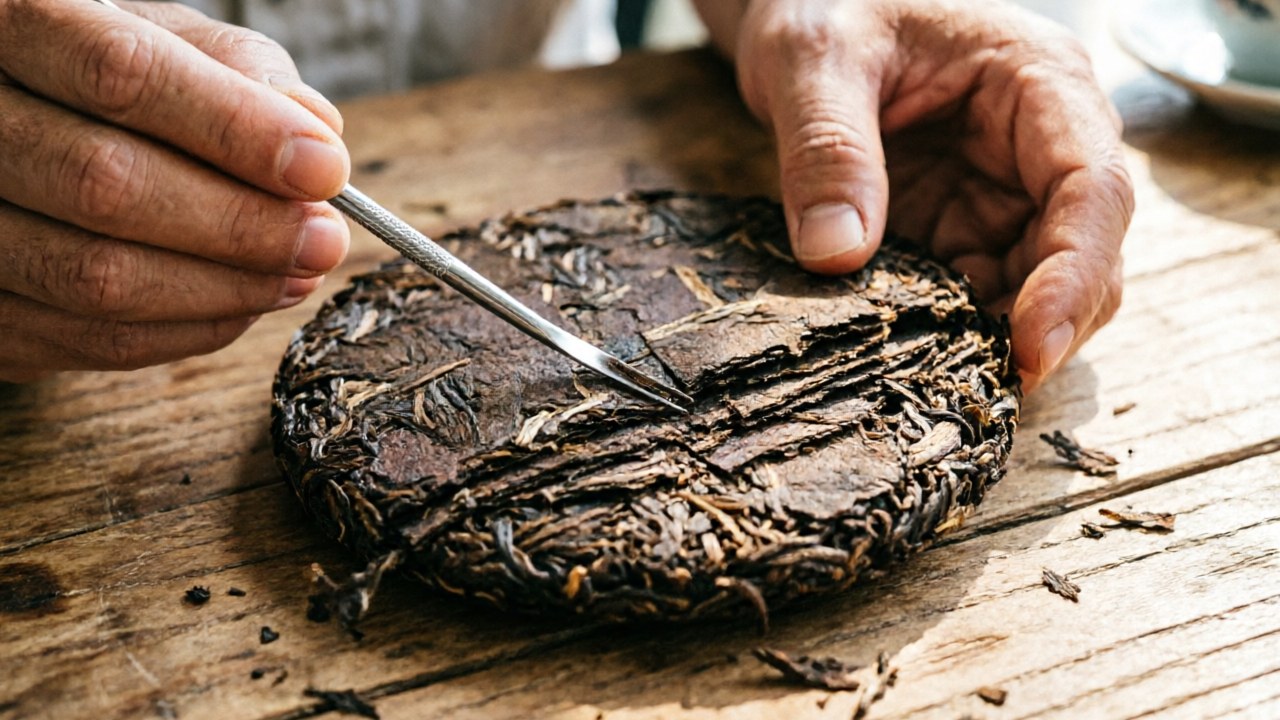
You must flake, not cut. Sawing through a puerh cake pulverizes the leaves into dust, which clouds the brew and creates bitterness from over-extraction [5]. The goal is to pry off thin sections that keep the leaf intact.
Insert a tea needle along the edge of the cake, about 1 cm deep, and pry gently downward. The layers should separate naturally along the grain of the compressed leaves. Work around the edge in small sections rather than driving through the center. A haowei tea knife, $9.99 has the right balance of stiffness and thinness for this.
The three common compression forms - bing (disk), tuo (bowl), and brick - all flake the same way, but tuo shapes have a tighter inner curve that requires working from the convex outside edge inward [1]. For bricks, start from a corner and work along the short edge. Whichever shape you have, aim for flakes about 5-8 grams each - enough for one gongfu session in a 100ml gaiwan. Avoid crumbling the cake interior, where the most dust accumulates during pressing.
Quick Reference - Sheng vs Shou Parameters
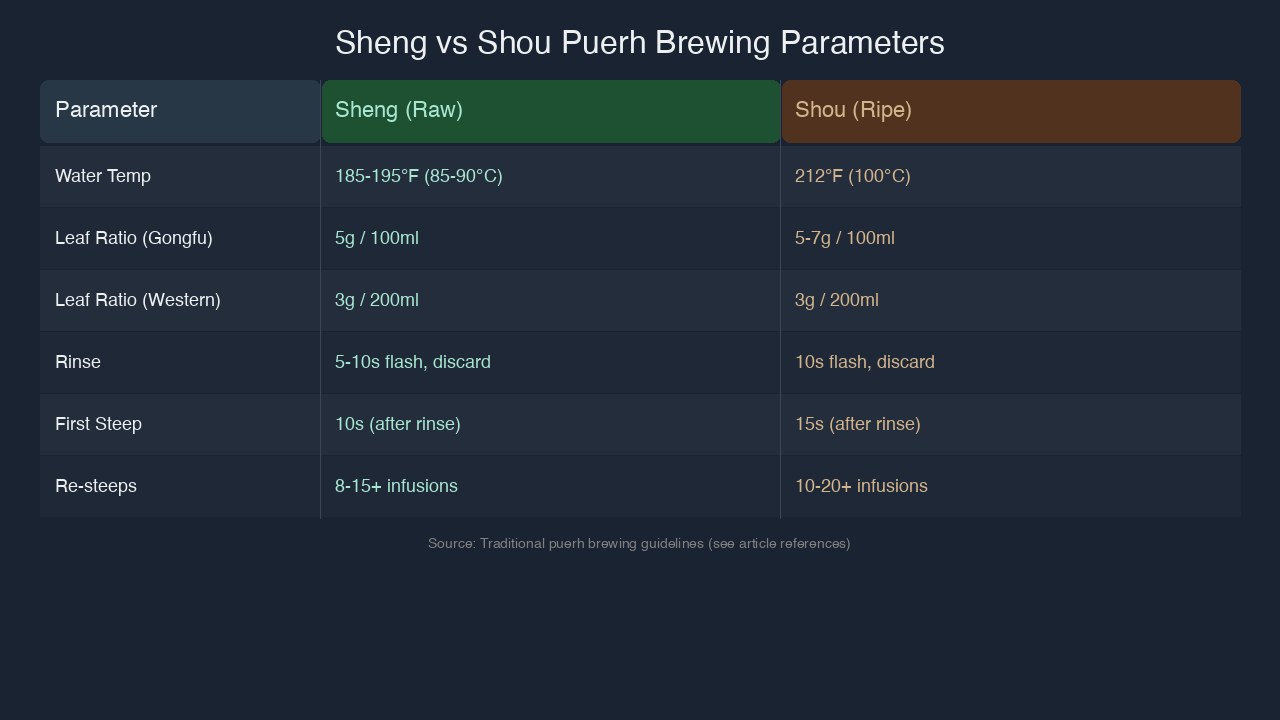
| Parameter | Sheng (Raw) | Shou (Ripe) |
|---|---|---|
| Water temp | 185-195°F (85-90°C) young / 205-212°F aged | 212°F (100°C) |
| Leaf ratio (gongfu) | 5g / 100ml | 5-7g / 100ml |
| Leaf ratio (Western) | 3g / 200ml | 3g / 200ml |
| Rinse | 5-10s flash, discard | 10s flash, discard |
| First steep | 10s (after rinse) | 15s (after rinse) |
| Re-steeps | 8-15+ | 10-20+ |
A Cosori gooseneck kettle with temperature control, $69.99 lets you dial 185°F for young sheng and 212°F for shou without guessing. If you don’t have a variable-temp kettle, let boiling water cool for 60 seconds in a cup before pouring onto young sheng [5]. The cooling method works but adds inconsistency - a 10°F swing between pours changes the cup.
Note the leaf ratio difference. Shou uses slightly more leaf (5-7g) because the wo dui fermentation compresses the leaves, and you need the extra mass to get full body. Sheng at 5g gives a balanced cup that won’t overpower [3].
The Rinse and Wake Protocol
Compressed puerh leaves are tightly rolled and dusty from pressing. A flash rinse opens the leaf surface and washes away particles that would otherwise make your first cup murky and flat [3].
Here is the protocol: pour hot water over the leaves, wait 5-10 seconds, then pour it off completely. Don’t drink the rinse. For shou puerh, extend to 10 seconds - this also clears the wo dui pile note, a fishy, damp-earth smell that clings to freshly fermented shou [1]. If the rinse still smells strongly of pile fermentation, do a second 5-second rinse.
For aged sheng (10+ years), the rinse becomes a “wake.” Aged compressed leaves have been sealed tight for years - they need a moment to remember they’re tea. A slightly longer 10-15 second rinse helps them relax and begin to open. Think of it as stretching before exercise - the leaves need that moment before they’re ready to give their best [3].
Use a Liang baobao porcelain gaiwan, $15.80 for rinse-and-pour. Porcelain is neutral, won’t absorb flavor, and the wide lid makes it easy to pour off the rinse quickly. The gaiwan is the right vessel for puerh because it drains fast - you don’t want the rinse sitting with the leaves.
Gongfu Method - Short Steeps, Long Conversations

Gongfu brewing is the traditional method for puerh. Short steeps, high leaf-to-water ratio, and many infusions. The session is a conversation with the tea - each steep reveals a different layer, and the progression from bright to deep is the whole point [2].
-
Weigh 5g of flaked puerh into a 100ml gaiwan. For shou, use 5-7g. A REOWONU gongfu set with gaiwan, $47.99 includes the gaiwan, cups, and strainer in one package.
-
Heat water to your target: 185°F for young sheng, 212°F for shou or aged sheng. See the gongfu brewing basics for the full method foundation, and the tea to water ratio guide for ratio reference.
-
Flash rinse (5-10s), then pour off completely into a JIUMEI glass cha hai, $12.98. The cha hai (fair cup) ensures every cup in the round has the same strength.
-
First steep: 10 seconds for sheng, 15 seconds for shou. Pour through a strainer into the cha hai, then serve.
-
Build up: Add 5 seconds per subsequent steep. By steep 5-6, the leaves have fully opened. Adjust time by taste from here [3].
-
Re-steep progression: Steeps 1-3 (10-20s), 4-6 (20-35s), 7-10 (35-60s), 11-15 (60-120s). Quality puerh gives 8-15 infusions for sheng and 10-20+ for shou [3]. The flavor shifts across the session - bright and floral early, deep and woody later. Track the changes by tasting each steep before adding time. The tea tells you when it’s done [3].
Western Method - One Patient Cup
For days when gongfu is too involved: 3g leaf per 200ml water in a pot or large infuser. Simple, forgiving, one cup at a time.
Sheng: 185°F, steep 2-3 minutes, one re-steep at +1 minute. Western works for young sheng if you keep the temperature down. Too hot and the cup turns bitter fast.
Shou: 212°F, steep 3-4 minutes, one re-steep at +1 minute. Shou is more forgiving in Western style - the fermented leaves don’t have the same bitterness threshold, and the longer steep time actually helps develop the depth that gongfu extracts in small doses [4].
Western brewing extracts differently than gongfu. You get fewer infusions (1-2 instead of 10+) but a fuller single cup with more body and less aromatic complexity. The trade-off is convenience for nuance - some drinkers prefer the straightforward cup, especially for shou’s earthy comfort [4].
For a no-fuss introduction to puerh flavor without gongfu equipment, Numi Organic Emperor’s Pu-erh tea bags, $7.40 give you ripe puerh in a standard tea bag. See our gongfu vs Western brewing comparison for when each method makes sense.
Common Puerh Brewing Mistakes
-
Boiling water on young sheng. Sheng leaves are unfermented. Full boil scorches them into bitterness. Fix: 185°F, not 212°F. A Cosori temperature-control kettle, $69.99 takes the guesswork out.
-
Skipping the rinse. Compressed leaves are dusty and tightly rolled. Without a flash rinse, your first steep is flat and murky. Fix: always 5-10s rinse, discard [5].
-
Overloading the gaiwan. Puerh leaves expand dramatically when wet. 5g in a 100ml gaiwan already fills the vessel by steep 3. More leaf than that and there’s no room for water. Fix: 5g max in 100ml.
-
Steeping too long early. A 30-second first steep drains the flavor profile, leaving later steeps thin and tired. Fix: start at 10s and build up.
-
Using one yixing for both sheng and shou. Yixing clay absorbs flavor. If you brew sheng and shou in the same pot, the flavors cross-contaminate within a few sessions - you’ll taste shou’s earth in your sheng and vice versa [5]. Fix: dedicate vessels, or use a porcelain gaiwan, $15.80 which is neutral. See our how to choose a gaiwan guide for vessel selection, and how to choose yixing clay for the dedication rule.
Recommended Puerh and Gear
If you’re starting from scratch, here is a minimal kit:
- Two practice cakes - one sheng, one shou. The TAETEA 7542 sheng, $23.99 and SANRAN 2015 shou, $28.99 let you taste the full sheng/shou split. On a budget, the LWXLJMJZC sheng, $9.99 and SANRAN 100g shou, $9.99 work as tasting-size cakes.
- A porcelain gaiwan - neutral, shows true flavor. The Liang baobao 6oz, $15.80 or the full REOWONU gongfu set, $47.99.
- A temperature-control kettle - non-negotiable for the sheng/shou split. Cosori gooseneck, $69.99.
- A tea knife for breaking the cake. haowei, $9.99.
To learn more about each type, see the sheng puerh variety page and the shou puerh variety page.
Where to Go Next
- Deepen your gongfu practice: gongfu brewing basics
- Compare methods: gongfu vs Western brewing
- Learn the leaf: sheng puerh and shou puerh
- Choose a vessel: how to choose a gaiwan
- All brewing guides: brewing hub
References
[1] Wikipedia contributors. “Pu-erh tea.” Wikipedia. https://en.wikipedia.org/wiki/Pu-erh_tea
[2] Wikipedia contributors. “Gongfu tea.” Wikipedia. https://en.wikipedia.org/wiki/Gongfu_tea
[3] Wilson, J. “Puerh Brewing Guide.” Mei Leaf Tea Blog. https://www.meileaf.com/blog/puerh-brewing-guide
[4] Heiss, M.L. and Heiss, R.J. The Story of Tea: A Cultural History and Drinking Guide. Ten Speed Press.
[5] Wilson, J. “How to Break a Puerh Cake.” Mei Leaf Tea Blog. https://www.meileaf.com/blog/break-puerh-cake
The Mind of Puerh
Puerh is the only tea that starts as one thing and becomes another. A young sheng cake is bright, bitter, alive - waiting decades to settle. Shou, meanwhile, has already arrived. Brewing puerh is not extraction; it is conversation. The rinse is the handshake. Each steep is a question. Some leaves answer for fifteen rounds.