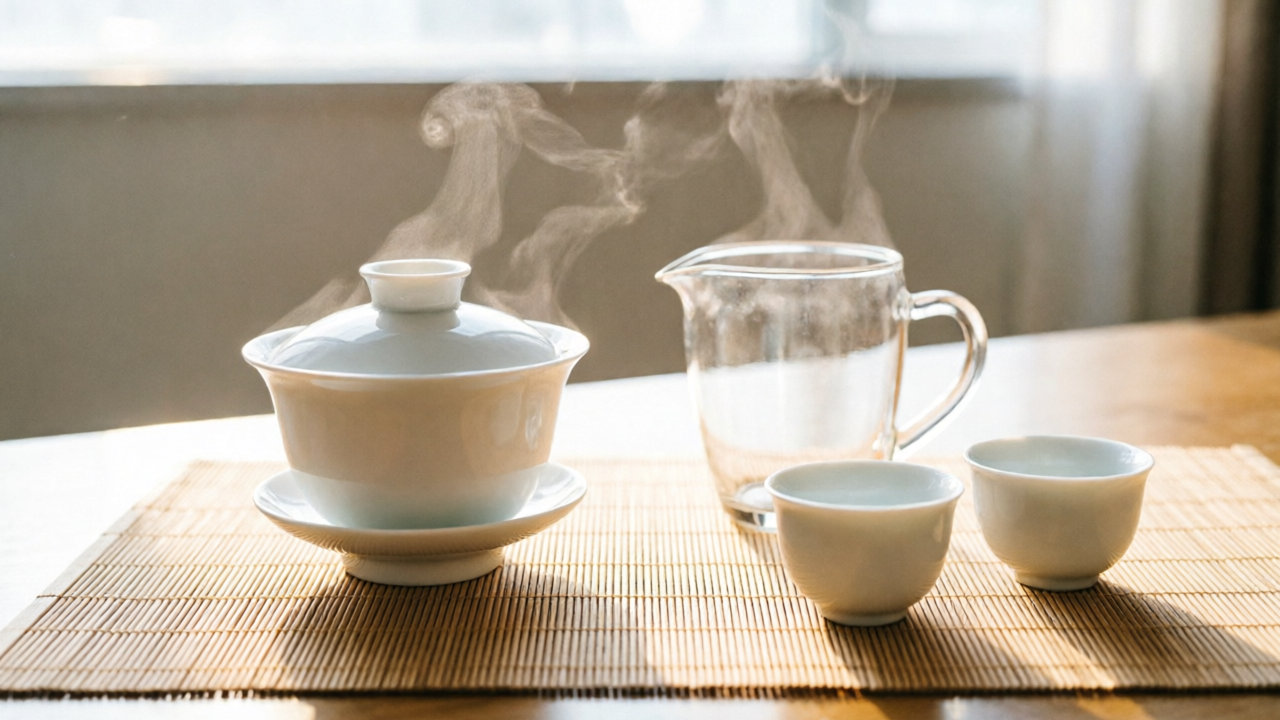
Gongfu brewing is a multi-steep skill tradition, not a ceremony. Where the ceremony page maps vessel roles and sequence, this is the brewing classroom — the practical parameters you need to brew gongfu at home without theater. Short steeps, high leaf ratio, and your full attention. This technique lives in the Special cups section of our brewing hub.
What You’ll Need for Gongfu Brewing
Gongfu equipment is straightforward. You don’t need a full set to start — but each piece serves a role that makes the technique easier to learn.
The Essential Vessels
A gaiwan is the best starting vessel for gongfu. A standard 150-200ml porcelain gaiwan costs $15-35, heats evenly, and handles every tea type from delicate green to compressed pu-erh. The wide opening lets you watch leaves unfurl, and the lid controls your pour speed.
A cha-hai (fairness pitcher) sits between the gaiwan and the cups. You decant the gaiwan into the cha-hai, then pour from there into individual cups. This ensures every cup gets the same strength — you don’t end up with one strong cup and one watery one [1].
Small tasting cups (30-50ml) force you to sip slowly rather than gulp. The small volume keeps each infusion hot and lets you taste the flavor evolution across multiple steeps.
If you’re starting from scratch, a complete set like the LURRIER Porcelain Chinese Gongfu Tea Set ($29.99) covers everything — gaiwan, cha-hai, cups, and tray. For a tighter budget, the LAVINTTO Chinese Tea Set 10-Piece Ceramic ($24.99) substitutes a small teapot for the gaiwan but retains the same brewing rhythm. The REOWONU Chinese Tea Set Gaiwan with 6 Cups ($34.99) is a solid gaiwan-first setup.
For solo sessions, the Gaolinci Kiln Glazed Jianzhan Teacup Gaiwan 5oz ($24.99) works as a combined brewing-and-drinking vessel — steep directly in it, sip from the same cup.
Kettle and Tray
A gooseneck kettle with variable temperature control makes gongfu much easier. You need different temperatures for different teas (85°C for green oolong, 100°C for pu-erh), and a gooseneck spout gives controlled pouring into a small gaiwan opening. The Fellow Corvo EKG Pro Electric Gooseneck Kettle ($149.99) is the gold standard — precise to the degree, with a built-in timer.
A bamboo tray catches rinse water and overflow. It’s not strictly necessary — any bowl or baking dish works — but a tray keeps your table dry and adds stability. The BambooMN Organic Bamboo Serving Tray 12x8 ($19.99) is simple and affordable.
Optional Extras
If you develop a dedicated gongfu practice with one tea type (oolong or pu-erh), a Yixing clay teapot seasons over time and enhances flavor. The Chinese Zisha Clay Tea Pot Handmade 180ml ($39.99) is a solid entry-level Yixing pot. A tea pet on the tray adds a traditional touch — the HonHeam Chinese Zisha Dragon Tea Pet ($14.99) is a common choice.
If you brew gongfu away from home, the Fanquare Portable Travel Tea Set with Bamboo Tray ($44.99) packs the whole setup into a carrying case.
Choosing Tea for Gongfu
Not every tea works well with the gongfu method. The best candidates are teas that unfurl or release flavor gradually across many short steeps.
| Best for gongfu | Why | Avoid |
|---|---|---|
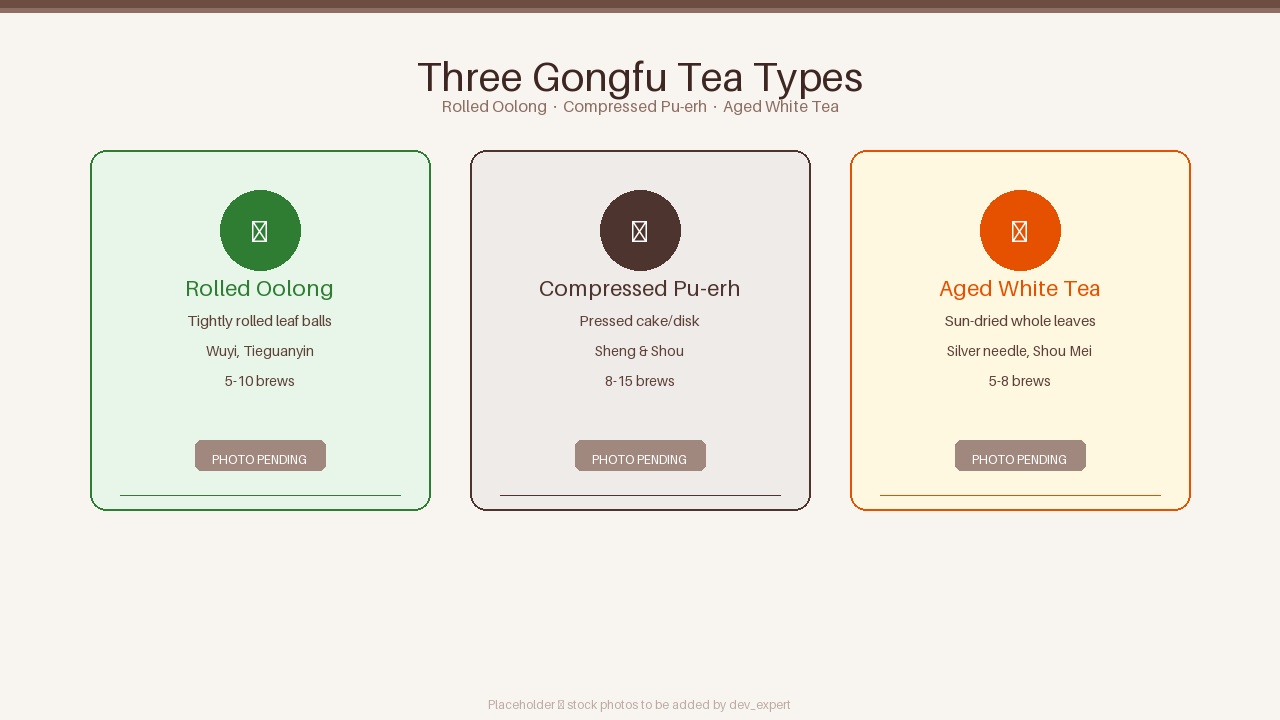
| Rolled oolongs (Tieguanyin, Dancong) | Unfurl over 7-10 steeps, flavor evolves | Broken leaf, bagged tea |
| Sheng and shou pu-erh | Dense cakes reward many infusions (10-15+) | Most flavored teas |
| Aged white tea (Shou Mei) | Gradual flavor evolution, 5-8 steeps | Very fine CTC (cuts-tears-curls) |
Green tea works gongfu-style but with fewer steeps (3-5) and cooler water. Black tea is possible but trickier — it extracts quickly and can turn bitter [1].
For your first gongfu session, pick a rolled oolong like Tieguanyin or a shou pu-erh mini cake. Both are forgiving and show clear flavor progression.
The Gongfu Brewing Method — Step by Step
This is the core technique. Execute these steps, and you’re brewing gongfu.
- Heat water to the right temperature for your tea (see the fine-tuning table below).
- Warm your vessels — pour hot water into the gaiwan, swirl, and transfer to the cha-hai and cups. This prevents heat loss during the first steep.
- Measure leaf — fill the gaiwan about 1/3 to 1/2 full for rolled oolongs. For compressed pu-erh, break off a piece roughly the size of your thumb joint.
- Rinse the leaf — pour hot water over the tea, steep 3-5 seconds, then discard. This awakens the leaf and removes surface dust [1].
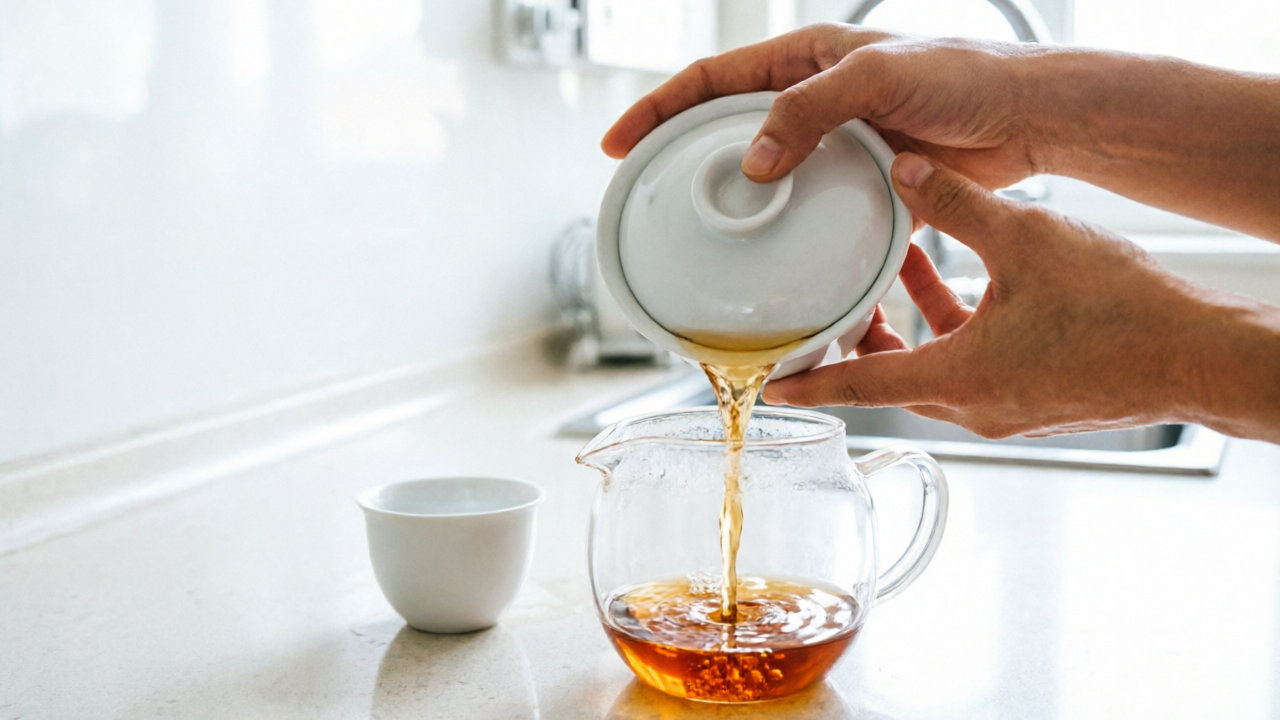
- First steep — fill the gaiwan, steep 10-20 seconds (adjust by tea type), then decant completely into the cha-hai.
- Pour and serve — from the cha-hai into individual cups, distributing evenly.
- Repeat — add 5-15 seconds per subsequent steep. Decant fully each time.
- Know when the leaf is spent — when the liquor turns pale and flavor thins. You’ll get 5-15 infusions depending on the tea.
Rinse Technique
The rinse isn’t about “cleaning” the tea. It’s about waking the leaf up. A rolled oolong is tight and dry; the rinse loosens the leaves so the first real steep extracts evenly. A 3-5 second flash pour is enough — don’t over-steep at this stage [1].
Decant Discipline
Decant the gaiwan completely every time. If you leave water sitting in the gaiwan between steeps, the leaf continues steeping in residual heat and releases bitter compounds. Tilt the gaiwan at a steep angle and drain every drop into the cha-hai. This is the most common beginner fix.
Leaf-to-Water Ratio and Steep Timing
Gongfu uses a much higher leaf-to-water ratio than Western brewing — roughly double the leaf for one-eighth the water. This ratio makes short steeps work: lots of leaf, very little water, very fast extraction [1].
The 5g/100ml Baseline
The standard gongfu ratio is about 5g of tea per 100ml of gaiwan capacity. By tea type:
- Rolled oolong: ~5g per 100ml (fills ~1/3 of gaiwan)
- Pu-erh: ~5-6g per 100ml
- Aged white: ~4g per 100ml
- Green/black gongfu: ~3-4g per 100ml
If you don’t have a scale, cover the bottom of the gaiwan with loose leaf. For rolled oolongs, the leaf should occupy roughly 1/3 of the gaiwan’s volume before you add water. After a few sessions, you’ll judge by feel [1].
Use our brewing ratio calculator to tune your exact gaiwan size.
Steep Time as Skill, Not Recipe
There’s no universal steep time chart because every tea steeps differently. Start with these guidelines and adjust by taste:
- First steep: 10-20 seconds (shorter for green oolong, longer for aged white)
- Second steep: 10-15 seconds (often faster than the first since the leaf is now open)
- Each subsequent steep: add 5-15 seconds
The steeping time guide lets you log your session and see your average times.
Fine-Tuning by Tea Type
This table gives specific parameters for six common gongfu teas. Treat the steep times as starting points — adjust based on your specific tea and your taste.
| Tea type | Water temp | Rinse? | First steep | Infusions | Pro tip |
|---|---|---|---|---|---|
| Rolled oolong | 95-100°C | Yes, 5s | 15-20s | 7-10 | Increase time faster for high-roast |
| Sheng pu-erh | 95°C | Yes, 5-10s | 10-15s | 10-15 | Young sheng: shorter steeps |
| Shou pu-erh | 100°C | Yes, 10s (wash 2x for aged) | 15-20s | 8-12 | Rinse twice for very aged cakes |
| Aged white | 90-95°C | Yes, 5s | 20-30s | 5-8 | Longer first steep than oolong |
| Dancong oolong | 100°C | Yes, 3-5s | 5-10s | 8-12 | Very short initial steep |
| Green (gongfu) | 80°C | Optional | 20-30s | 3-5 | Cooler water, fewer infusions |
For a visual guide, start with a rolled oolong — it’s the most forgiving entry to the technique. If you want to understand how the same vessel handles different teas, check out the how to choose a gaiwan guide for size and material recommendations.
Beginner Mistakes and How to Fix Them
Every beginner makes these mistakes. Here’s how to spot and fix them.
- Too little leaf → weak, watery flavor. Fix: measure by gaiwan volume, not teaspoon. Use the 5g/100ml ratio as your baseline and adjust up before you adjust down.
- Water too cool for oolong → flat extraction, no fragrance. Fix: boil water. Don’t guess at temperature — a variable-temp kettle like the Fellow Corvo EKG Pro eliminates the guesswork.
- Oversteeping the first infusion → bitterness masks the tea’s character. Fix: start shorter than you think. 10-15 seconds for the first steep. You can always steep longer next time, but you can’t un-steep bitter tea.
- Not decanting completely → lingering water over-extracts and ruins subsequent steeps. Fix: tilt the gaiwan fully. Every drop out.
- Wrong vessel for the tea → a gaiwan that’s too large dilutes the flavor. For solo gongfu, stick with 150-200ml. The Gaolinci Kiln Glazed Jianzhan Gaiwan ($24.99) at 150ml is ideal for one person.
If you’re just getting started with loose-leaf tea generally, the first-cup brewing guide covers the Western method for everyday mugs. For a full starter kit walkthrough, see teaware for beginners.
The Mind of Gongfu Brewing
Gongfu brewing is a practice of attention, not speed. Each short steep reveals something new — the first tells you about the harvest, the fifth about the mountain. Use a small vessel, pour fast, and let the tea set the pace. The flavor changes with every infusion, and that conversation is the point.
References
[1] Gongfu tea — Wikipedia. https://en.wikipedia.org/wiki/Gongfu_tea