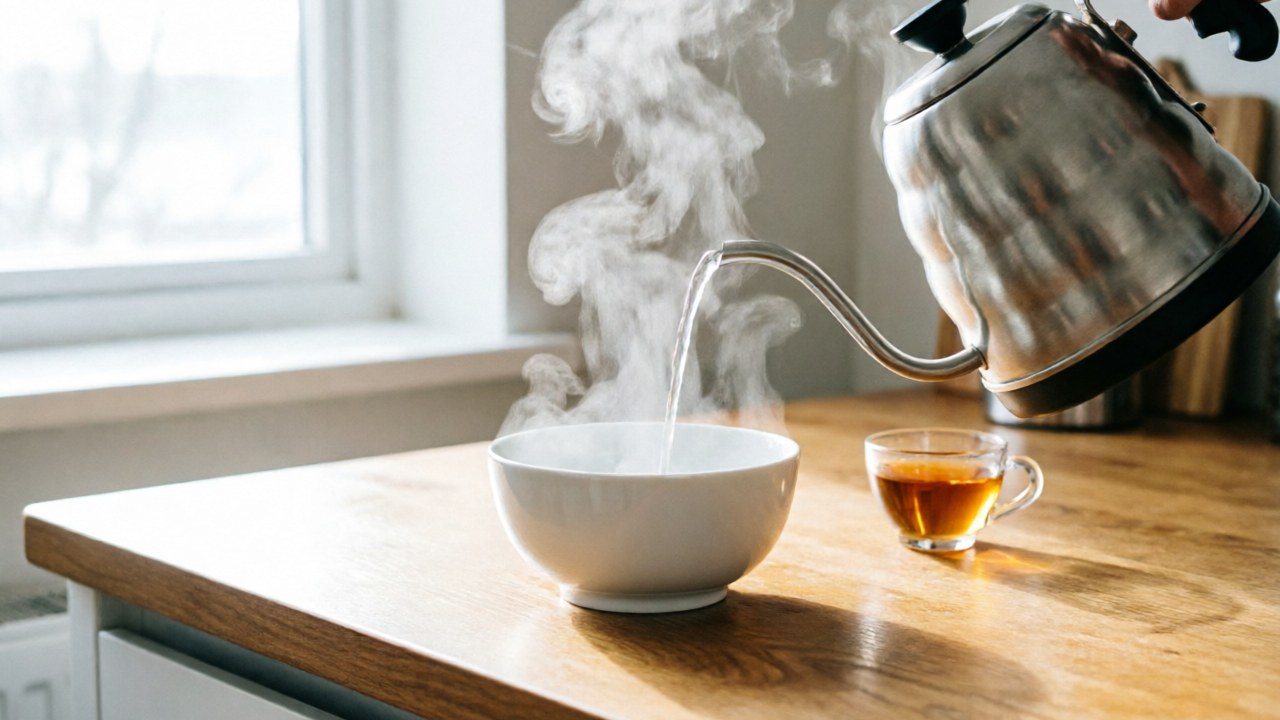
Every tea type has an ideal water temperature — white 70–80°C, green 75–85°C, oolong 85–95°C, black and puerh 95–100°C, herbal 100°C. But the chart is only half the story. Your water cools faster than you think the moment it leaves the kettle. A cold pot steals 5–10°C. And at 5,000 feet above sea level, water can’t even reach a true boil. This guide covers how to actually hit the right temperature, what goes wrong, and how to fix it.
The Quick Reference Chart
Here’s the temperature range each tea type prefers, with a one-line reason why.
| Tea Type | °C | °F | Why |
|---|---|---|---|
| White | 70–80 | 158–176 | Delicate buds scorch above 80°C |
| Green | 75–85 | 167–185 | Chlorophyll turns bitter at boiling |
| Oolong | 85–95 | 185–203 | Semi-oxidized leaves need heat to open |
| Black | 95–100 | 203–212 | Full oxidation tolerates near-boil |
| Puerh | 95–100 | 203–212 | Compressed aged leaves need max extraction |
| Herbal | 100 | 212 | Dried herbs and spices require full boil |
Green tea is the most temperature-sensitive — even a few degrees too hot pulls bitter tannins from the chlorophyll [2]. If you’re just starting, a Chefman variable-temp kettle with 5 presets takes the guesswork out of hitting these ranges. For more on each tea type’s brewing parameters, see our how to brew green tea guide.
How to Hit Target Temp Without a Variable-Temp Kettle
You don’t need a $90 kettle to brew great tea. Here are three methods that work with any kettle.
The Boil-and-Wait Method
Bring water to a full boil, then wait:
- 5–6 minutes for green and white tea (~80°C)
- 2–3 minutes for oolong (~90°C)
- Pour immediately for black, puerh, and herbal (100°C)
This is the simplest approach, and it gets you within a few degrees. The catch: the wait time depends on your kettle size and room temperature. A 1.7L kettle holds heat longer than a 0.8L one. Once you’ve done it a few times, you’ll develop a feel for your own setup.
Visual Bubble Cues
Traditional Chinese tea practice — dating back to Lu Yu’s The Classic of Tea in the 8th century — describes four bubble stages that correspond to temperature ranges [3]:
- “Shrimp eyes” (~70–80°C): Tiny pinhead bubbles form at the bottom of the kettle
- “Crab eyes” (~80–85°C): Larger bubbles rise slowly from the bottom
- “Fish eyes” (~85–90°C): A steady stream of large bubbles
- “Rope of pearls” (~95–100°C): Rolling boil with continuous, vigorous bubbles
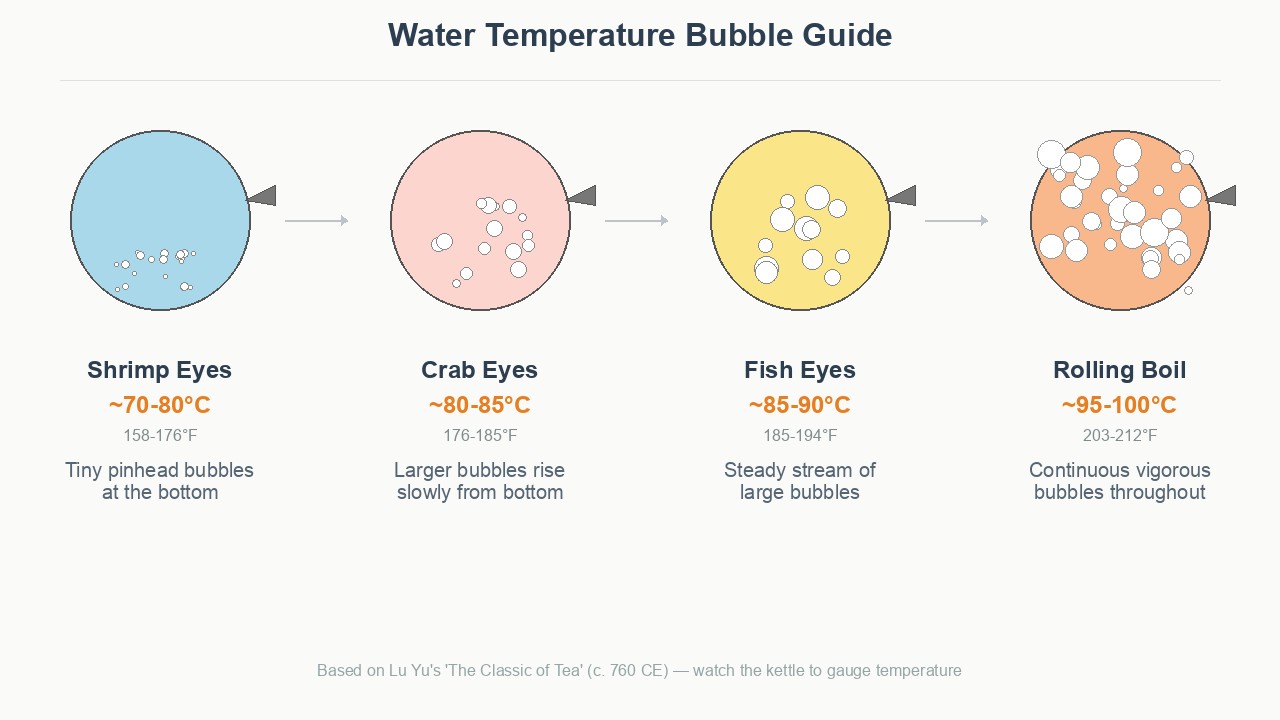
This method takes practice but costs nothing. Watch your kettle next time and try to match the visual to the temperature.
The Transfer-Cool Trick
Pour boiling water into a room-temperature cup first, then from that cup into your teapot. The water drops about 5–8°C in the transfer — enough to bring boiling water down to a safe green tea range if you’re in a hurry.
For verification, a CDN clip-on thermometer costs less than ten dollars and clips onto any kettle rim. Check your water once with it, note how long your boil-and-wait takes, and you’ll rarely need it again. For gongfu brewers who want pour precision, a Cosori gooseneck kettle gives you both temperature control and a slow, targeted pour.
Want the full brewing system? Start with our how to brew tea guide.
Why Your Water Cools Faster Than You Think
Here’s something most temperature charts skip: the temperature you pour isn’t the temperature your leaves actually see.
Pouring boiling water into a cold, room-temperature teapot drops the water 5–10°C instantly. That means if you’re targeting 85°C for oolong and you pour into an un-warmed pot, your leaves are actually steeping at 75–80°C. The result is thin, under-extracted tea.
The fix: Pre-warm your vessel. Pour a splash of hot water into the pot, swirl it for a few seconds, and discard. This simple step eliminates the temperature drop and is standard practice in both gongfu and Western brewing.
Know Your Vessel’s “Drop Number”
Try this: pour boiling water into your usual brewing vessel, wait 30 seconds, and measure with a thermometer. The difference between 100°C and the reading is your vessel’s “drop number.” A thick-walled porcelain gaiwan might drop 3°C. A thin glass pot might drop 8°C. Knowing this lets you compensate — heat your water a few degrees above target if you’re in a rush and can’t pre-warm.
Speaking of glass, a PARACITY glass teapot lets you watch the leaves unfurl while brewing — the fast heat loss is actually a plus for delicate green and white teas.
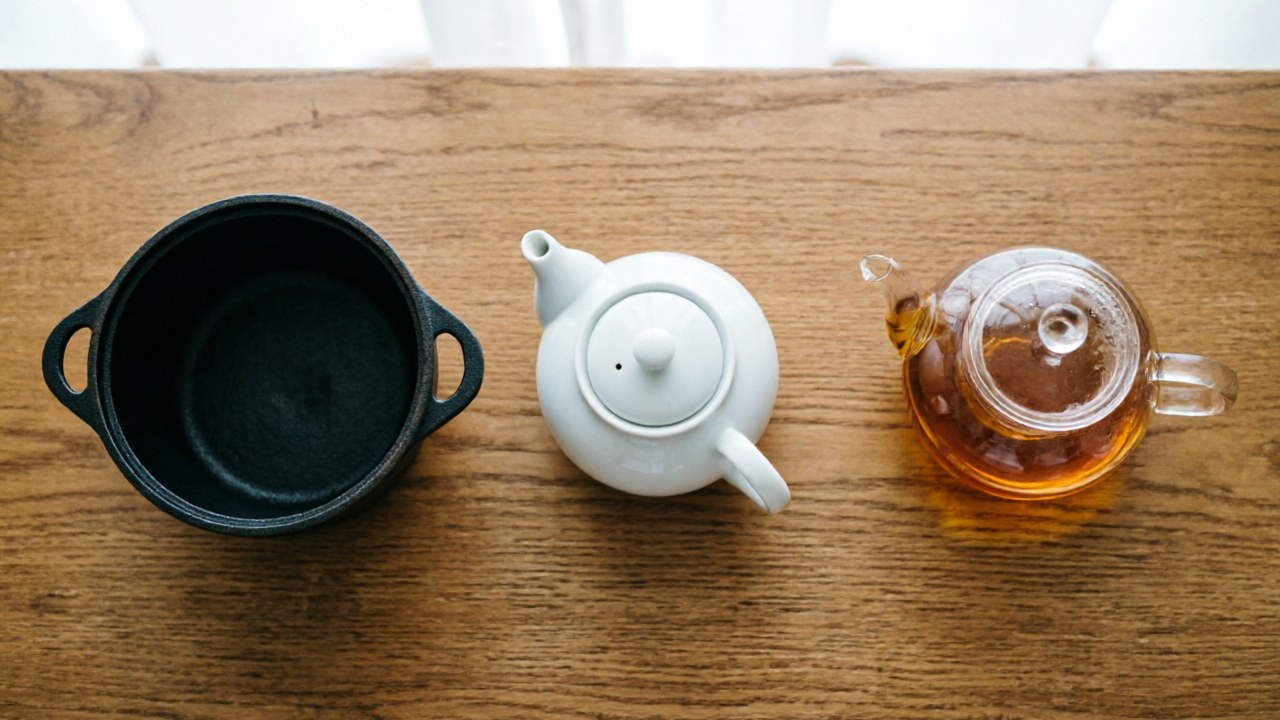
Cast Iron vs Porcelain vs Glass
| Material | Heat Retention | Best For |
|---|---|---|
| Cast iron | Highest — sustains high temp longest | Black, puerh (needs sustained heat) |
| Porcelain | Moderate — versatile middle ground | All tea types |
| Glass | Lowest — cools fastest | Green, white (fast cooling protects delicate leaves) |
For white tea — the most temperature-sensitive of all — see our how to brew white tea guide.
Altitude and Boiling Point
Water boils at 100°C only at sea level. As you climb, the boiling point drops — roughly 1°C for every 285 meters (935 feet) of elevation gain [1].
| Elevation | Boiling Point |
|---|---|
| Sea level | 100°C (212°F) |
| 1,500m / 5,000ft | ~95°C (203°F) |
| 3,000m / 10,000ft | ~90°C (194°F) |
If you live in Denver (1,600m), your “boiling” water maxes out at about 95°C. You literally cannot brew black or puerh tea at true 100°C. The practical rule: at altitude, use water immediately off the boil for all tea types — it’s already cooler than the chart targets recommend, and the sustained heat from fresh boiling helps compensate.
Re-steeping: When to Raise the Temperature
Later infusions often need a small temperature bump to keep extracting flavor.
- Gongfu style: After the 3rd or 4th infusion, raise the temperature 2–3°C. The leaves have released their easiest compounds; a bit more heat coaxes out the rest.
- Puerh and oolong: Designed for many steeps. Raise temp 2–3°C per infusion after the 3rd.
- Green and white: Rarely re-steep more than twice. Same temperature, slightly longer steep time works better than raising heat.
A Teabloom sandglass timer set to your tea type’s steep window pairs naturally with temperature awareness — the two parameters work together. For the full ratio-and-time picture, see our tea to water ratio and tea steeping time guides.
Common Water Temperature Mistakes
1. Boiling water on green tea
This is the single most common mistake. Boiling water hits the chlorophyll in green tea leaves and pulls out bitter, astringent tannins within seconds [2]. The cup tastes grassy, harsh, and one-dimensional.
Fix: Wait 5 minutes after boiling, or use a variable-temp kettle set to 80°C. Even a budget model pays for itself in better-tasting green tea.
2. Not pre-warming the vessel
A cold pot drops your water 5–10°C on contact. If you’re already brewing at the edge of the temperature range (say, 75°C for white tea), that drop pushes you into under-extraction territory.
Fix: Swirl hot water in the vessel for 5 seconds before brewing. Discard, then brew.
3. Re-boiling water repeatedly
Each boil drives off dissolved oxygen. After 2–3 boils, the water tastes flat and lifeless — the tea loses its brightness and aroma.
Fix: Use fresh cold water each time. If you must re-boil, limit it to once.
4. Trusting kettle presets without verification
Kettle preset accuracy varies by ±3–5°C depending on brand and calibration. A kettle labeled “80°C” might deliver 76°C or 84°C.
Fix: Verify once with a thermometer, then trust the preset. A clip-on thermometer costs under $10 and is the highest-ROI purchase for any tea drinker.
5. Same temperature for all teas
Using boiling water for everything produces universally mediocre results — scorched greens, acceptable blacks, under-developed oolongs.
Fix: Start with a simple two-temperature system: 80°C for green and white, 100°C for everything else. A COMFEE’ glass kettle with 6 presets handles this easily. For the full range, a Cuisinart PerfecTemp with keep-warm function is the upgrade.
Puerh actually rewards high heat — it’s the one tea that genuinely needs near-boiling to open up properly. See our how to brew puerh guide for specifics.
Tools for Temperature Control
You can spend $9 or $90 on temperature control. Here’s how the tiers break down:
Tier 1 (under $35): A clip-on thermometer plus any standard kettle. Verify your water manually, then use the boil-and-wait method. This is the highest-ROI setup for any tea drinker.
Tier 2 ($35–70): A glass kettle with presets, like the COMFEE’ with 6 temperature settings. You get visual confirmation plus push-button accuracy.
Tier 3 ($70–100+): A gooseneck variable-temp kettle like the Cosori for gongfu brewers who need precise pour control, or a Cuisinart PerfecTemp for daily convenience with 30-minute keep-warm.
Where to Go Next
Temperature is one of three parameters that define your brew. The other two:
- Tea to water ratio — how much leaf to use
- Tea steeping time — how long to steep
- How to brew tea — the complete first-cup system
Or browse all brewing guides.
References
[1] Engineering Toolbox, “Water Boiling Points at Higher Pressures” — https://www.engineeringtoolbox.com/boiling-point-water-d_926.html (boiling point vs elevation / atmospheric pressure data) [2] Labbe D, et al. (2006), “Catechin kinetics in aqueous extracts of green tea,” Journal of Agricultural and Food Chemistry, 54(8): 2923–2928 — https://pubs.acs.org/doi/10.1021/jf052549t [3] Lu Yu, The Classic of Tea (茶經, c. 760 CE), Chapter 4, translated by Francis Ross Carpenter (1974). Reference text widely available; see also https://www.britannica.com/topic/Tea
The Mind of Temperature
Water temperature isn’t a rule to memorize — it’s a relationship to learn. The fragile buds of white tea recoil from a boil. The compressed layers of puerh demand it. Read the bubbles, know your vessel, trust your tongue. The right degree is the one that makes your tea taste alive.