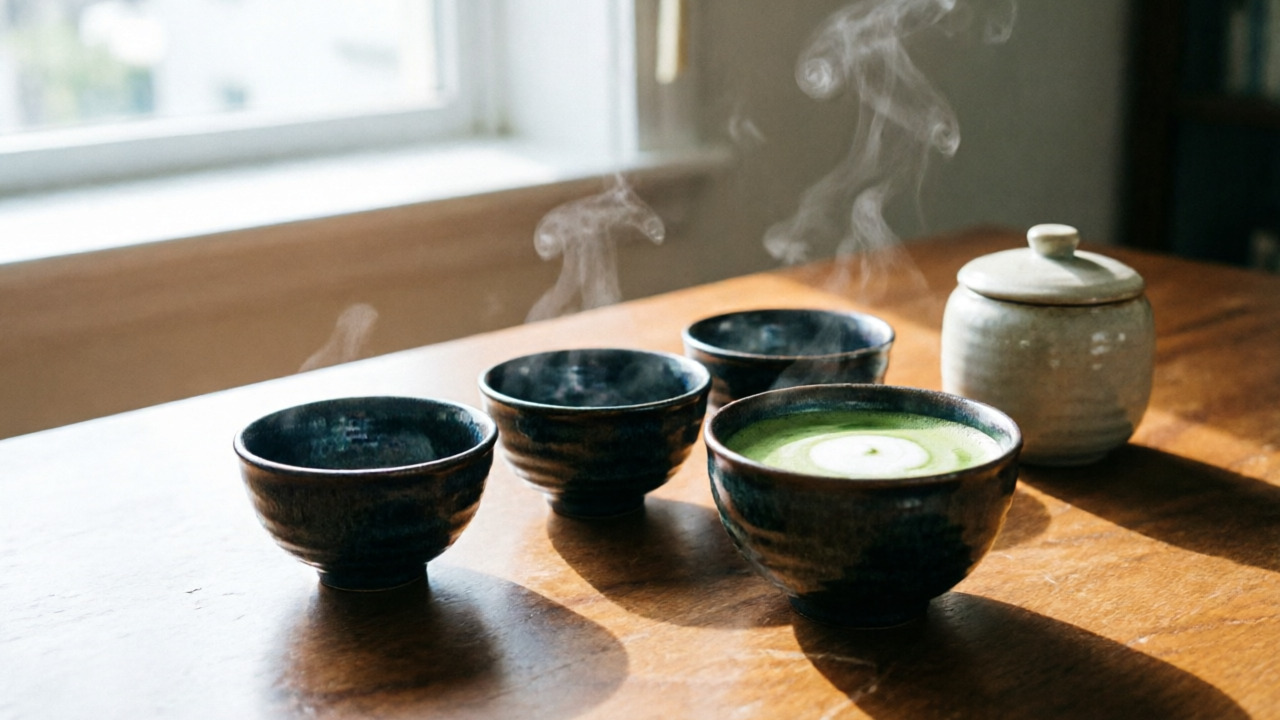
Jian ware appreciation is eye training in clay and chemistry, not a catalog of auction prices. Before chasing Song Yohen bowls or market estimates, learn to read what the kiln wrote: the foot ring, glaze pooling, and crystallization patterns. Name one glaze detail today; let study become buying only after the eye settles.
This page sits on the Fine vessels lane of Teaware — craft study first, not auction lists, not brand rankings, not a buying guide disguised as history.
Why Jianzhan Trains the Eye
Jian ware was not designed as display pottery. Under Emperor Huizong (1100–1126 CE), the Song court popularized doucha (tea fighting) — a competition where participants whisked powdered tea into a thick white froth [1]. The bowl that showed the froth best won. Dark-bodied Jianzhan, with its iron-saturated glaze that absorbed light rather than reflecting it, created the ideal visual contrast. The white froth stood out against the black field the way pale green tea liquor still does today.
The form itself was engineered for this purpose: conical walls for whisking clearance, a thick rim for heat retention, a small foot that sits securely in one hand. Every design choice was functional, not decorative. This is the first lesson Jianzhan teaches the eye: form follows function. When I hold a Jianzhan bowl, I’m reading a tool designed for a specific tea practice — not an ornament.
This functional context changes how you look at the bowl’s lip shape, wall thickness, and foot ring — the same markers I’ll use later for examination.
The Jianyang Kilns and Their Iron-Rich Clay
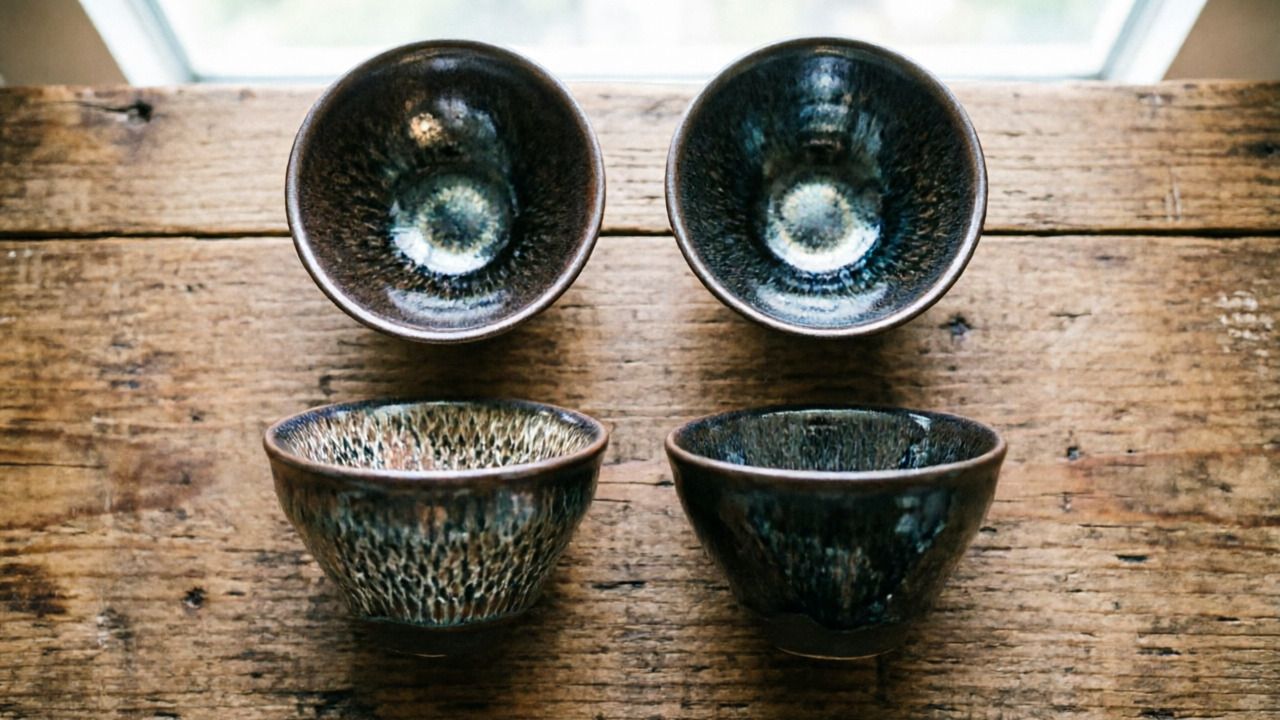
The Jianyang kiln complex in northern Fujian province — primarily the village clusters of Houjing, Chayuan, and Luhua — produced the original Song Jian ware across several centuries [2]. These were dragon kilns built on slopes, up to 100 meters long, that could fire hundreds of bowls in a single continuous chamber. The kiln architecture mattered: the long flame path created varied atmospheres along the chamber, producing different glaze effects at different positions.
The defining material was the local clay, containing 8-9% iron oxide — far higher than typical stoneware clays [2]. In a reducing (oxygen-starved) atmosphere, this iron vitrifies into a dark, almost metallic body. The unglazed foot ring shows this as dark brown to near-black with visible kiln grit.
Modern Jianyang revival studios still source clay from the same region. The Jianyang Master Cup is a larger-format piece made from contemporary Jianyang clay — a useful reference for how the iron-rich body performs under modern firing.
The Three Great Glaze Families
From the same iron-saturated glaze formula, kiln atmosphere and cooling rate produce three visual families [3]:
Hare’s Fur (Nōgime)
The most common Jian pattern. As glaze flows down the bowl walls at ~1300°C, iron oxide crystallizes into fine vertical streaks resembling fur — ranging from russet brown to silver to iridescent blue depending on kiln position.
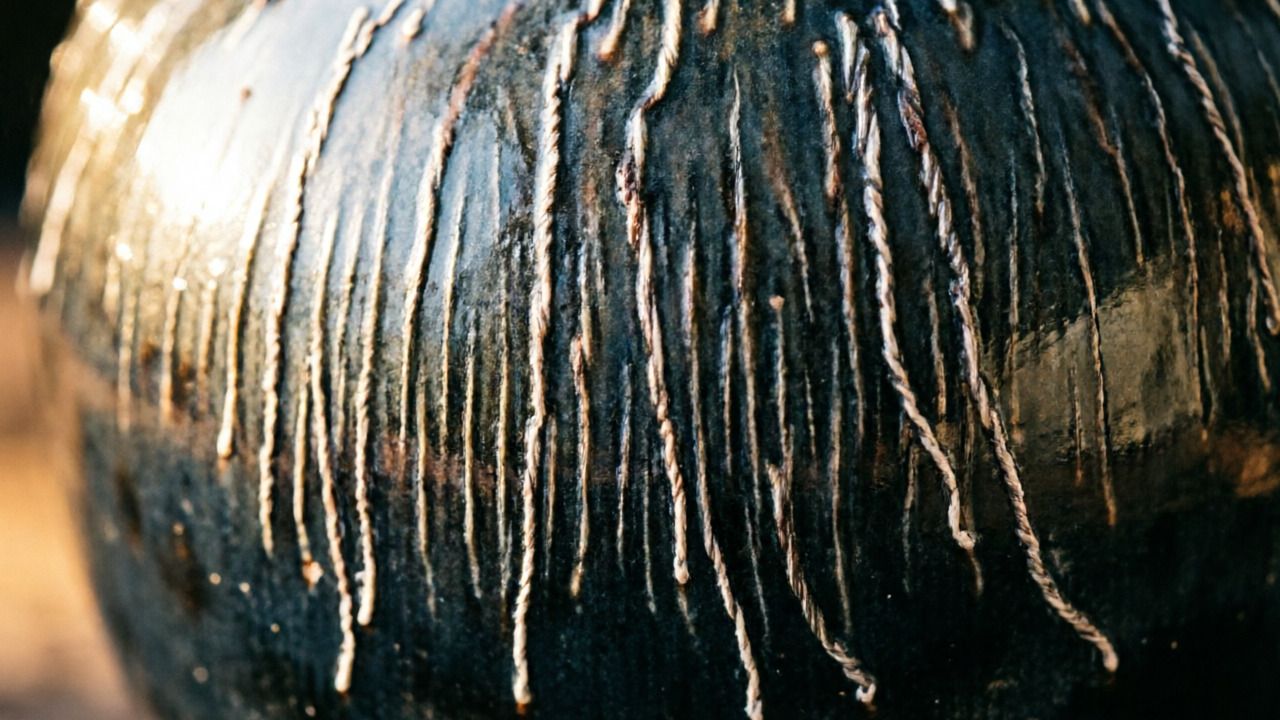
The Apingjenz Hare’s Fur bowl (120ml) is the most accessible entry point — $15.99 with clear vertical streaking in a standard gongfu portion.
Oil Spot (Yuteki)
Rarer than hare’s fur. Iron oxide bubbles break through the glaze and crystallize into metallic silver or bronze spots during cooling. The narrower firing window makes them less common.
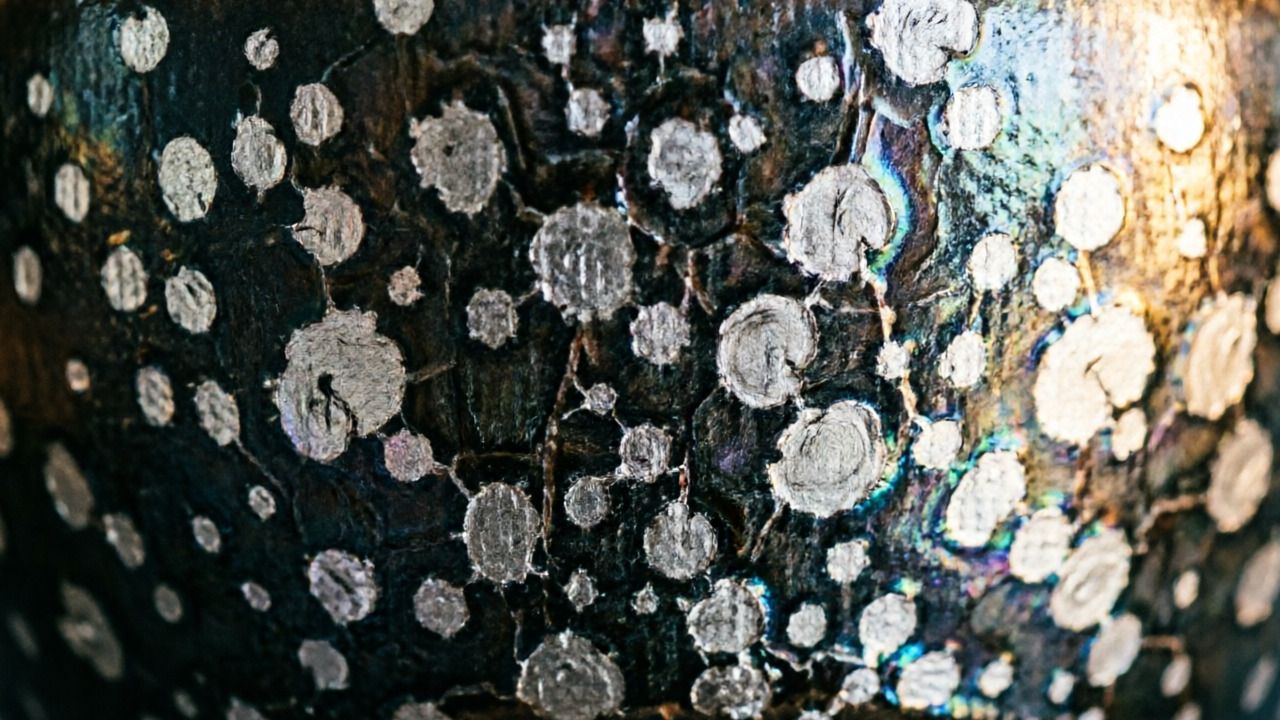
The Apingjenz Oilspot bowl (80ml) demonstrates this pattern in a small solo-session size. A more advanced variation — the Oilspot with Tears bowl — shows how glaze pooling can create droplet-like “tears” at the glaze edge, a useful marker for understanding how glaze flows during firing.
Skyeye (Yohen)
The rarest of the three. An oil-spot base with iridescent blue-green halos from thin-film interference during precise cooling [3]. Only three surviving Song Yohen bowls are known — all in Japan, all National Treasures. Even modern kilns achieve the effect only occasionally.
The Apingjenz Skyeye bowl (120ml) approximates the multi-colored kiln effect — it trains the eye to recognize the blue-green halo that defines this family.
From Jianyang to Japan: The Tenmoku Legacy
In 1191 CE, the monk Eisai (Yōsai) returned from his studies in China carrying tea seeds and Jian ware bowls [4]. His treatise Kissa Yōjōki, the first Japanese book on tea, recorded the benefits of powdered tea drunk from dark bowls. The name “Tenmoku” derives from Tianmu Mountain near the Chinese monasteries where Japanese monks studied.
Japanese tea culture developed four Tenmoku types that map directly to the Chinese glaze families:
| Tenmoku type | Chinese equivalent | Key feature |
|---|---|---|
| Yohen | Skyeye | Iridescent blue-green halos |
| Yuteki | Oil spot | Metallic silver/bronze spots |
| Nōgime | Hare’s fur | Vertical iron streaks |
| Tamo | Plain brown-black | Solid dark glaze, no pattern |
The three surviving Song Yohen bowls — held at the Seikadō Bunko Art Museum, Ryūkō-in (Daitoku-ji temple), and the Fujita Museum — are the most revered Jian pieces in Japan [4]. In chado (the Way of Tea), these bowls connect practitioners to tea’s continental origins. To understand how these bowls fit within the full arc of Japanese tea bowl traditions, see the chawan lineage article.
Modern study pieces like the Oilspot with Tears bowl let you compare a contemporary interpretation against the historical classifications.
How to Examine a Jianzhan Bowl: Four Visual Markers
This is the practical core of appreciation work. Each marker below is something you can check from a photo or from a bowl in your hand — no lab equipment required [2][3].
1. Foot Ring
Look at the unglazed ring at the base. Authentic Jian ware leaves the foot ring exposed — the iron-rich clay fires to dark brown or near-black with visible kiln grit. Mass-produced bowls often have a glazed or painted foot.
2. Glaze Pooling Above the Foot
Genuine Jianzhan shows a thick, uneven glaze line stopping just above the foot ring with visible drip marks — evidence of hand-dipping. On the Oilspot with Tears bowl, this pooling effect is particularly visible where the glaze thickened before freezing during cooling.
3. Clay Body Color
The exposed clay at the foot should be dark — not white, beige, or light gray. Traditional Jian clay fires to a chocolate-brown or charcoal-black. A light-colored body means the piece was made outside the Jianyang tradition, using a different clay formula.
4. Lip Contour
The rim should be slightly indented — a conical profile rather than straight. This shaped the drinker’s mouth position for controlled sipping of hot whisked tea. A straight rim suggests modern mass production.
For practice, the Apingjenz Hare’s Fur bowl (120ml) and the Larger Hare’s Fur (160ml) are good study pieces — affordable enough to examine these four markers directly without worrying about value preservation.
Modern Jianzhan Revival
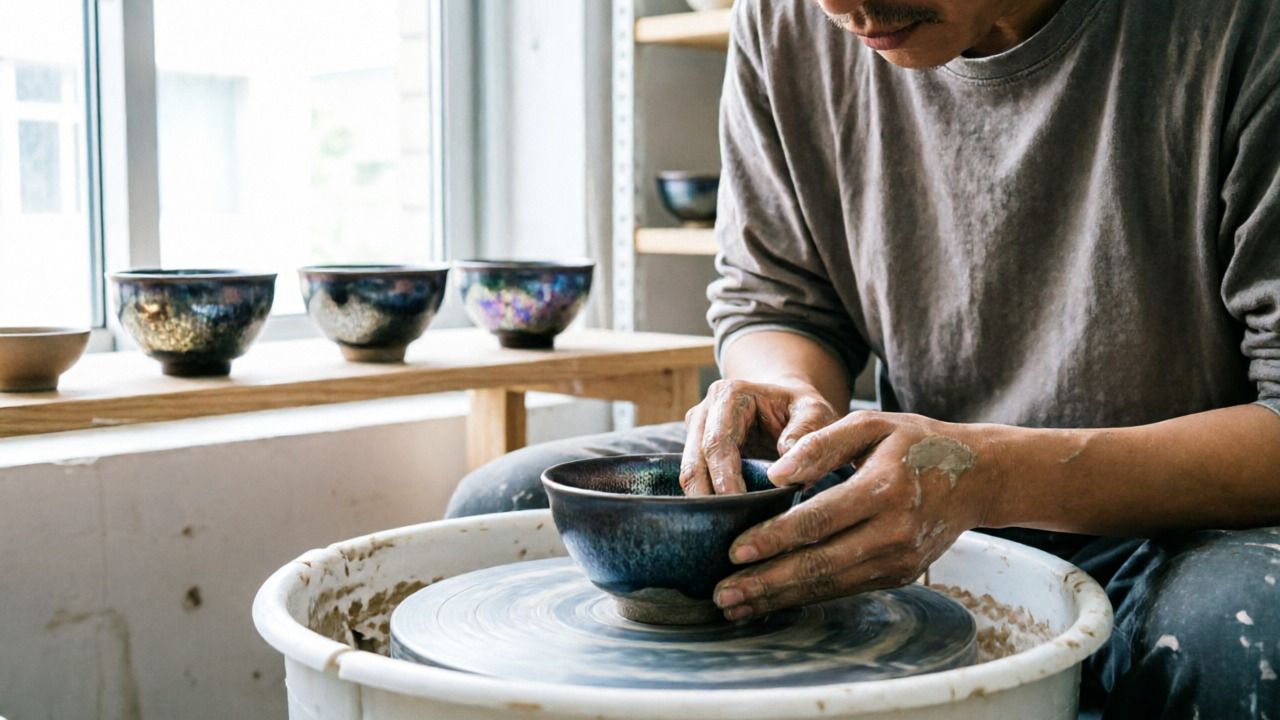
After the Song Dynasty, Jianyang kiln production declined. The shift to loose-leaf brewing reduced demand for the whisking-optimized Jian bowl.
The revival began in the 1980s–1990s, when researchers and artisans in Jianyang began reconstructing traditional firing techniques [5]. Today, hundreds of studios produce Jianzhan bowls, from daily-use pieces ($10-30) to master-level works ($100-500). Modern kilns allow more consistent control, but glaze patterns still depend on the same iron-oxide chemistry and reducing atmosphere.
What to look for in a modern piece: clarity of pattern definition (streaks should be crisp, not muddy), glaze thickness (visible pooling at the lower body), and foot finish (the clay body should show the same dark iron-rich color as historical pieces). The Apingjenz Bloom bowl and the large Matcha Jianzhan bowl show the range of modern work — bloom-style floral kiln effects and Jian glaze in matcha-bowl proportions.
Caring for a Jianzhan Bowl
Jianzhan is durable stoneware, but the unglazed foot and porous glaze surface need mindful care.
- Cleaning: Rinse with hot water only. No soap — the iron-saturated surface can absorb chemical residues. For stubborn tea stains, a soft cloth and warm water is enough.
- Drying: Air dry upside-down on a soft cloth, or wipe dry. The unglazed foot ring absorbs moisture, so ensure it’s fully dry before storage.
- Seasoning: Some practitioners dedicate a single bowl to one tea type (particularly dark oolongs or shou pu-erh), allowing the porous foot to absorb the tea’s character over time. This is optional, not required.
- Storage: Avoid stacking bowls directly — the glaze surface can scratch. Use a soft cloth between bowls if stacking. Store in a stable location away from rapid temperature changes.
For broader protocols, see the teaware care guide.
When Study Becomes Buying
Study first — learn to identify the three glaze families and the four visual markers before buying anything beyond one study piece. Here’s a practical path:
-
Start with one bowl: The Apingjenz Hare’s Fur (120ml) at $15.99 is the ideal first study piece — affordable, daily-drinkable, with clear hare’s fur pattern.
-
Add a comparison piece: The larger 160ml hare’s fur at $24.99 lets you compare how the same glaze type varies between firings.
-
Choose by session size: 80ml for solo gongfu, 120ml for sharing, 300ml+ for matcha. The Jianyang Master Cup ($35.77) is a larger format from the Jianyang region.
This page belongs to the study cycle — not a buying guide. For first-vessel decisions, see how to choose a gaiwan. For clay vessel upgrades, see how to choose a Yixing teapot. New to vessel selection? Start with teaware for beginners.
Path Rails — Where This Page Sits
This page belongs to the Appreciate lane on the Teaware hub — for readers who want to study vessels as craft, not just buy the first option [6]. If you’re new to vessel selection, start with the teaware for beginners path. For daily drinking decisions, see how to choose a gaiwan.
The four appreciate articles — yixing classics, this page, chawan lineage, and gaiwan history — each train a different eye: Yixing for silhouette, Jianzhan for glaze chemistry, chawan for kiln traditions, gaiwan for vessel anatomy.
For understanding how Jianzhan bowls function within Japanese ceremony practice, see matcha tea ceremony. For the full vessel system, explore the teaware for tasting path.
The Mind of Jianzhan
A Jianzhan bowl is fire and chemistry frozen in a single glaze line. Each pattern — hare’s fur streak, oil spot bloom, skyeye halo — is a kiln moment never repeated. To study Jianzhan is to train the eye in patience: read the foot ring, notice the glaze pooling, sit with one bowl and see something new. Today, name one glaze detail you haven’t noticed. That single observation is the beginning of craft appreciation.
References
[1] Kyoto National Museum — “Tenmoku Teabowls” collection notes and exhibition records. (kyohaku.go.jp) [2] Wikimedia Foundation — “Jian ware” — kiln site survey, clay composition, and firing methods. (en.wikipedia.org/wiki/Jian_ware) [3] Tezumi — “Guide to Tenmoku Part 1: Origins and Glaze Families” — kiln atmosphere, cooling rate, and glaze family classification. (tezumi.com) [4] Museum of Fine Arts, Boston — Jian ware and Tenmoku collection records, including transmission history via Eisai’s Kissa Yōjōki. (mfa.org) [5] Metropolitan Museum of Art — “Jian Ware: Song Dynasty Stoneware” — modern revival context and kiln technology reconstruction. (metmuseum.org) [6] Teaware hub — “Fine Vessels” lane organizing appreciate-type guides for vessel study. (/teaware/#appreciate)