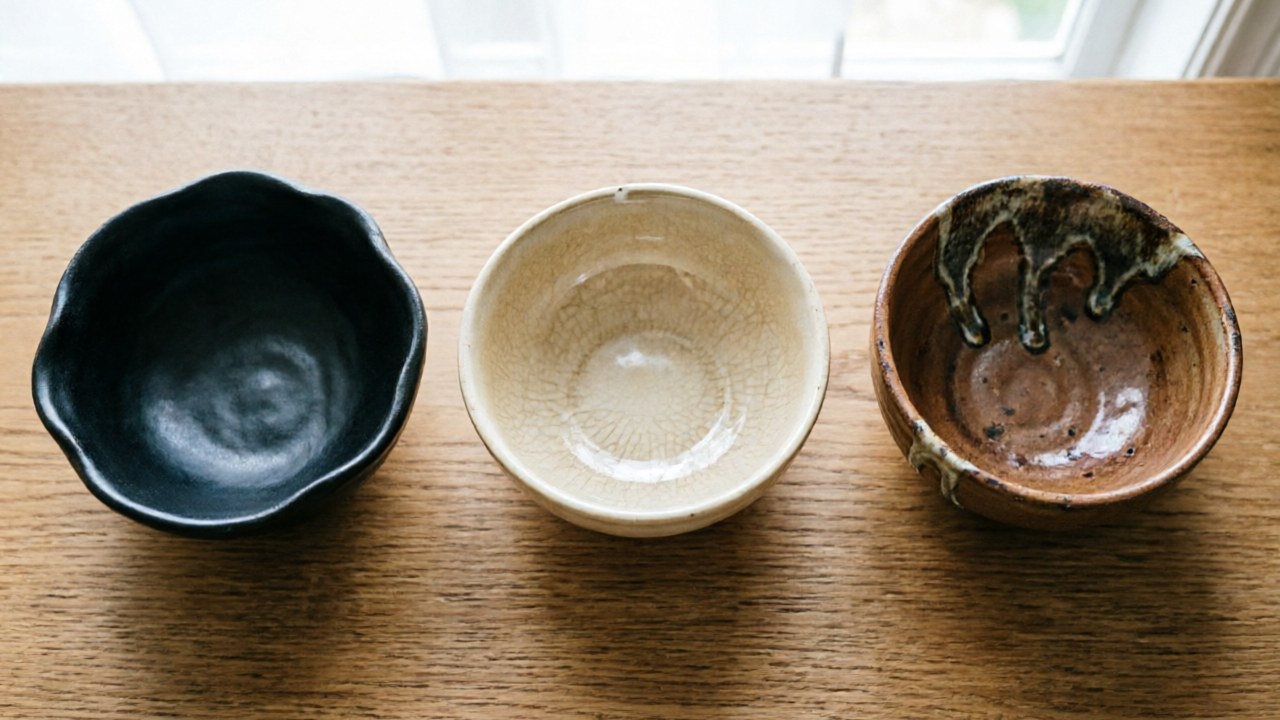
Chawan lineage isn’t a list of bowl types. It’s a genealogical study: every chawan carries the fingerprint of a kiln tradition, a tea master’s philosophy, and centuries of Japanese ceramic evolution. This guide traces that lineage from Chinese Song dynasty Jian ware to the six great kiln traditions still made today, then shows you how to read a bowl the way a tea practitioner does.
This page sits on the Fine vessels lane of Teaware: eye training first, not auction catalogs, not brand rankings.
The Lineage of Chawan: From Chinese Jian Ware to Wabi-Cha
Chinese Origins: Jian Ware and Tenmoku
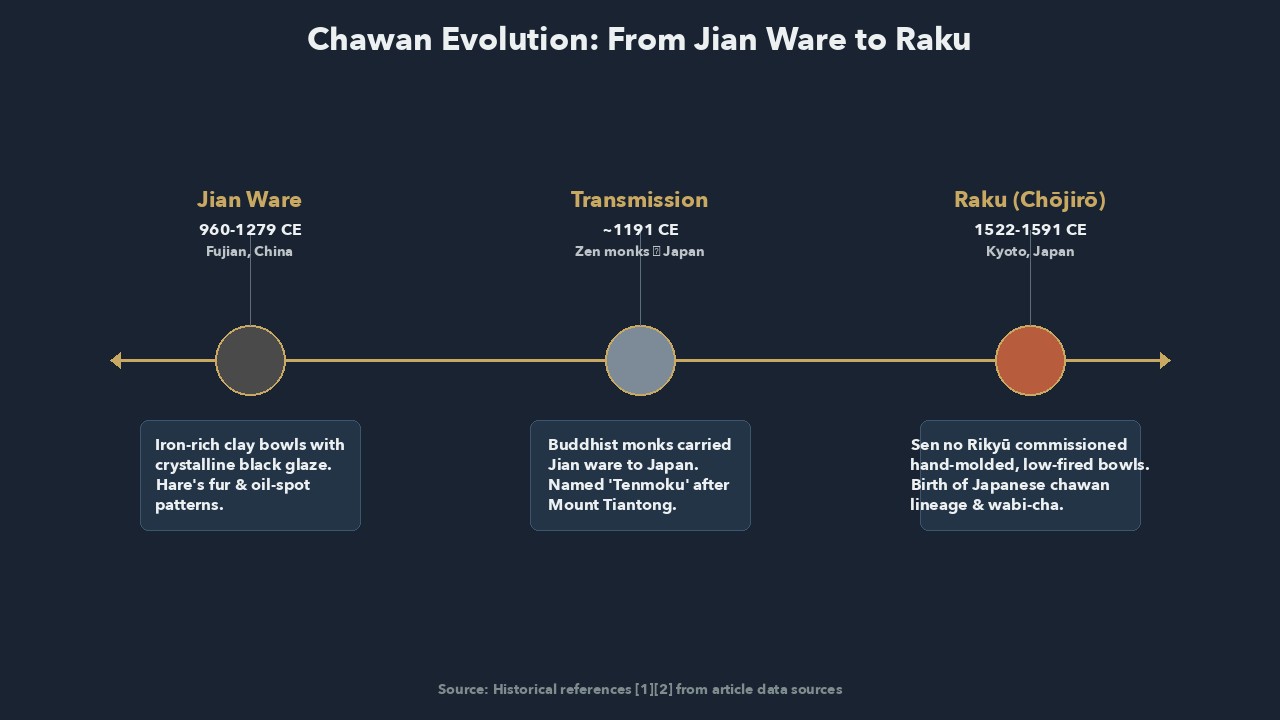
The chawan story begins not in Japan but in Fujian, China. Song dynasty (960-1279 CE) tea competitions demanded bowls that could show the white of whisked tea foam against a dark glaze [1]. Jian ware (Jianzhan), fired in dragon kilns at Jianyang, used iron-rich clay that produced crystalline patterns: hare’s fur streaks and oil-spot blazes across a black field.
Zen monks carried these bowls back to Japan in the 12th and 13th centuries [1], where the name “Tenmoku” stuck: derived from Mount Tiantong (Tianmushan), a departure point for monks traveling between Chinese and Japanese temples. If you see a small-mouthed, high-footed dark bowl labeled “Tenmoku chawan,” it traces this lineage.
Sen no Rikyū and Wabi-Sabi Adaptation
The pivot from imported Chinese bowls to a distinctly Japanese aesthetic happened in the 16th century. Sen no Rikyū (1522-1591 CE) [2] codified wabi-cha: a stripped-back tea practice that valued irregularity, humility, and the hand of the maker over technical perfection. He commissioned the potter Chōjirō to make hand-molded Raku bowls, low-fired and deliberately uneven, the first chawan lineage born on Japanese soil. To understand the cultural frame Rikyū operated within, read about chado: the Way of Tea and its philosophy of mindful practice.
Six Kiln Traditions That Define Chawan
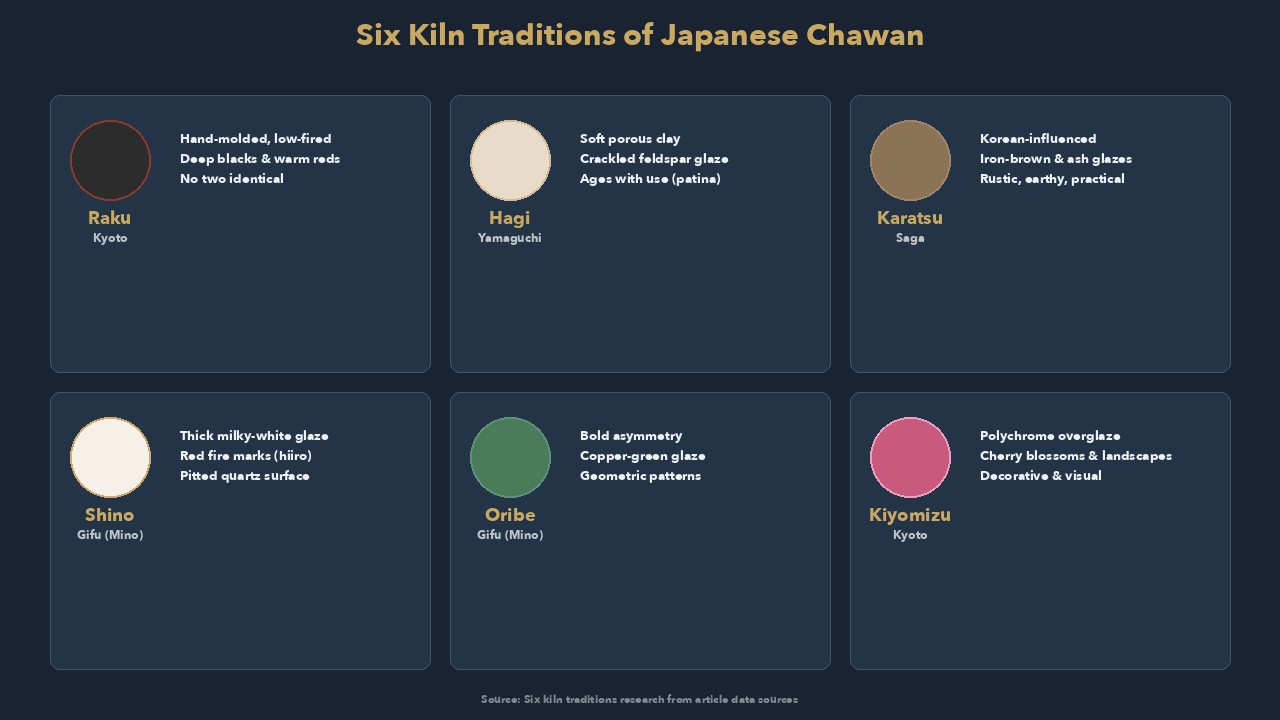
Each tradition below is a distinct aesthetic lineage with recognizable traits. Not an exhaustive catalog: six lineages that cover most chawan you’ll encounter.
Raku
Hand-molded (not wheel-thrown), low-fired, and rapidly cooled. Each Raku chawan is unique, with no two identical. Lead glaze produces deep blacks (Aka-Raku) or warm reds. Carved initials in the foot identify the potter. To study Raku’s hand-molded quality first-hand, the KIMIKURA Mt. Fuji chawan is a contemporary Japanese-made bowl that captures the tradition’s tactile irregularity.
Hagi
Soft, porous clay from Yamaguchi prefecture. Thick feldspar glaze in warm whites and creams. Over years of use, the glaze develops minute cracks (kan-nyū) that absorb matcha color, deepening the patina. The glaze is the experience: a Hagi chawan ages with you. The handcrafted beige matcha bowl echoes Hagi’s warm, porous character for daily practice.
Karatsu
Korean-influenced stoneware from Saga and Nagasaki. Iron-brown and rice-straw ash glazes. Rustic, practical, earthy. The split between Iro-Karatsu (painted) and Ki-Karatsu (yellow) shows how one tradition can produce wildly different surfaces from the same clay body. A traditional clay chawan gives you Karatsu’s earthy, grounded feel for your own tea corner.
Shino
Mino ware from Gifu. Thick, feldspar-rich white glaze with distinctive red “fire color” (hiiro) at the edges where the clay shows through. Pitted surface from quartz in the clay body. Muji Shino (plain) sits beside E-Shino (painted with iron underglaze designs). For a first-hand look at Mino ware, the Waraku Fuuka handcrafted chawan offers a current handcrafted Japanese bowl for comparison with historic regional forms.
Oribe
Also Mino ware, named after Furuta Oribe, who was Rikyū’s disciple. Bold asymmetry, copper-green glaze (ao-Oribe), and geometric or pictorial patterns carved into the surface. Oribe is the avant-garde spirit within chado: deliberately distorted shapes, intentionally irregular rims. Where Raku is quiet, Oribe is theatrical.
Kiyomizu
Kyoto ware from the Gojōzaka district. Polychrome overglaze painting (iro-e) with refined, decorative motifs: cherry blossoms, mountain landscapes, seasonal flowers. Less wabi, more visual celebration. Kiyomizu chawan are often display-worthy, but many are fully functional for daily matcha.
Chawan Shapes: Form Follows Ceremony
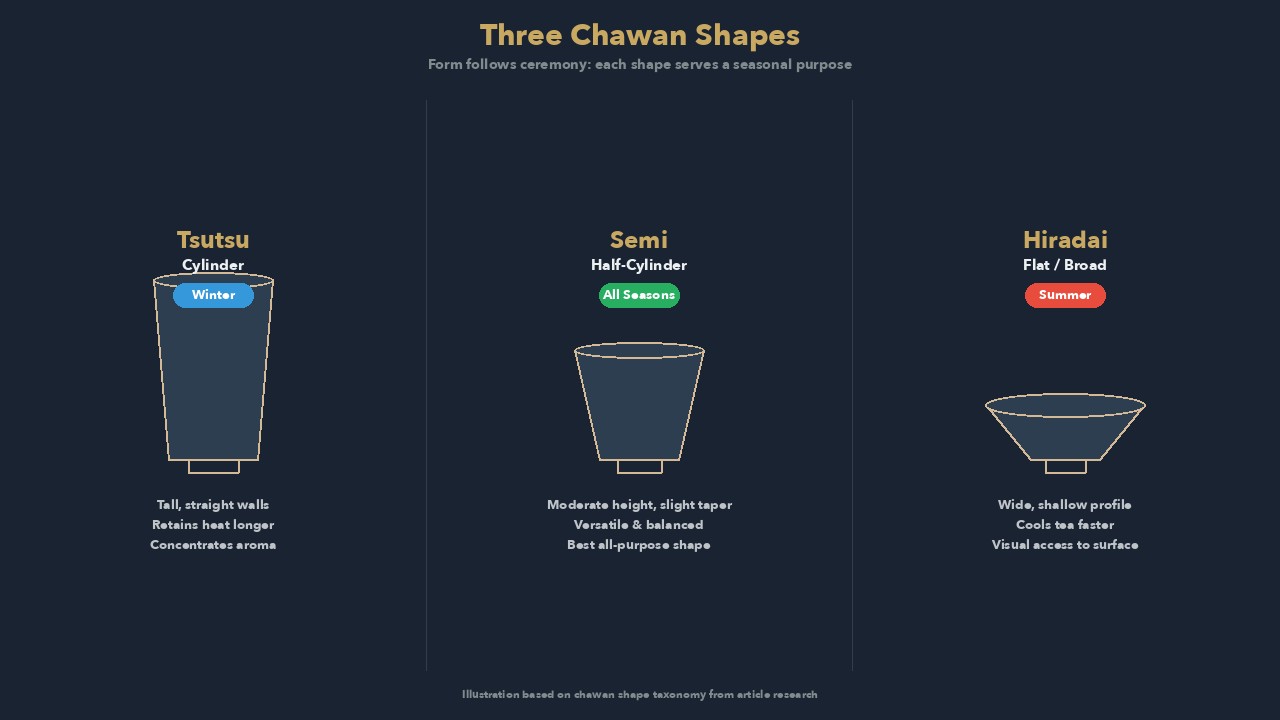
Shape dictates how a bowl functions in tea ceremony. Three primary shapes cover most chawan you’ll encounter.
Tsutsu (Cylinder)
Tall, straight walls. Used in winter because the narrow opening retains heat longer. The tall profile also concentrates matcha aroma toward your nose. Makes the tea feel warmer in hand.
Semi (Half-Cylinder)
Moderate height with a slight taper. The most versatile chawan shape: balance of heat retention and visual access to the matcha surface. If you buy one chawan for all seasons, a semi shape is the safest default.
Hiradai (Flat/Broad)
Wide, shallow profile with a flat foot. Used in summer because the broad surface cools tea faster. The open shape invites visual appreciation of the whisked matcha surface and foam.
Named Historical Shapes
Beyond the three seasonal types, look for Ido (Korean-influenced, tall foot), Tenmoku (high foot, small mouth, adapted from Chinese imports), and Gōsu (curving walls like a spinning top). These names appear in museum labels and serious catalogs. Knowing them sharpens your eye without requiring you to own examples.
Tea Ceremony Chawan vs. Everyday Use
Ceremonial chawan are named, handled with prescribed rituals, and rotated seasonally: tsutsu in winter, hiradai in summer. They’re part of a chabana or scroll display, and each bowl carries a history of who made it and who owned it.
Everyday chawan are a different animal. Modern ceramic or porcelain, machine-made or studio pottery, in the $15-50 range. They serve daily matcha without ceremony, and they’re meant to be used hard. If you’re just starting your matcha practice, a 9-piece matcha tea set includes a serviceable chawan alongside a chasen and accessories so you learn the full workflow at once.
The best first chawan is one you actually use, not one that sits on a shelf. For a deeper look at what a beginner needs in teaware, see teaware for beginners. And to see the chawan in its native ceremonial context, visit our matcha tea ceremony guide.
How to Read a Chawan: Signatures, Marks, and Provenance
Where to Find the Signature
The base of the foot (kōdai) is where most chawan carry their chōmei: a stamped or incised signature. Common characters include 樂 (Raku), 萩 (Hagi), and 唐津 (Karatsu). A chawan with its original wooden box (tomobako) will also carry calligraphy on the box lid, often by the potter or a tea master. A chawan without a box requires more experienced eyes to attribute.
Kintsugi and the Aesthetic of Repair
Gold lacquer repair, known as kintsugi, is not damage control but continuation of the chawan’s story. A kintsugi-repaired chawan can be more valuable than an undamaged one, especially if the repair was done by a recognized artisan. The crack becomes a gold river across the glaze, a visible record of the bowl’s second life.
A Collector’s Starter Checklist
What to look for when examining a chawan:
- Foot ring quality - clean cutting, proportionate to the bowl’s weight
- Glaze evenness - intentional variation vs. sloppy application
- Kiln marks - natural firing evidence, not defects
- Hagire vs. kan-nyū - structural cracks (hagire, bad) vs. legitimate glaze craquelure (kan-nyū, good)
For calm reading context on chado philosophy while you build your eye, The Book of Tea by Okakura Kakuzō is a slim classic written in English that frames the entire aesthetic without auction prices or brand rankings.
When Appreciation Becomes Buying: Your First Chawan
Appreciation leads naturally to owning. One good chawan teaches more than reading about a hundred.
Match to the kiln tradition that pulls you: Hagi’s soft glaze, Karatsu’s earthy strength, Raku’s sculptural uniqueness. Buy what you love looking at. For daily matcha, a sturdy semi chawan in the $30-50 range works well. For ceremonial practice, consider a traditional Raku or Hagi piece at $50-200.
If you need a chasen to pair with your chawan, the premium matcha whisk set covers the whisk, scoop, and holder. For a complete toolkit that includes sifter and scoop alongside the whisk, the matcha accessories kit fills the remaining gaps. And the Waraku Fuuka handcrafted chawan at $25.99 is an accessible handcrafted bowl for daily matcha.
For broader vessel selection guidance, see our how to choose Yixing teapot guide. To think about building a full collection rather than buying one piece, visit build your teaware system.
Common Mistakes in Chawan Appreciation
- Confusing reproductions for originals. Many contemporary Raku and Hagi chawan are modern studio interpretations, not Edo-era antiques. Appreciate both, but know the difference. A $30 studio Raku and a $3,000 Edo-period Raku share a lineage but not a history.
- Obsessing over signatures before form. A signed chawan from a known kiln isn’t automatically better than an unsigned one. Judge the bowl first: does it feel right in your hands, does the lip sit comfortably against your mouth, does the glaze reward repeated looking?
- Neglecting usability for rarity. A chawan that’s too wide for your palms, too shallow for proper whisking, or too heavy to hold for a full tea session is a bowl you won’t use. Utility is part of its beauty.
- Buying based on glaze photos alone. Chawan is tactile. The weight, the lip feel, the sound of the clay when tapped: these matter as much as the glaze pattern. Photos flatten a three-dimensional object into two.
Where Chawan Appreciation Sits on the Site
This article is part of the appreciate lane on Teaware: fine vessels worth studying. For a parallel appreciation guide on Yixing clay teapots, see Yixing classics. To understand the tools that pair with a chawan, visit matcha tools.
References
[1] Metropolitan Museum of Art. “Jian Ware: Song Dynasty Tea Bowls from Fujian.” MetPublications. https://www.metmuseum.org/toah/hd/jian/hd_jian.htm
[2] Varley, Paul. “Sen no Rikyū and the Origins of the Japanese Tea Ceremony.” Japanese Culture. University of Hawaii Press. https://www.uhpress.hawaii.edu/titles/japanese-culture
The Mind of Chawan Lineage
A chawan is never just a bowl. In its clay you read a Chinese Song dynasty, a Zen monk’s journey, a tea master’s rebellion, and a potter’s lifetime of fire. To appreciate chawan lineage is to understand that every bowl carries not one story but centuries of hands that shaped, held, and poured into it.
Sip slowly. Think deeply. Live mindfully.