The useful question isn’t whether tea is “good” or “bad” for sleep. It’s whether a cup still contains caffeine, how close it sits to bedtime, and what ritual replaces it. A six-hour caffeine cutoff, a four-level leaf ladder, and a 30-minute bedtime tea ritual give you three separate levers instead of one vague rule.
This is a general adult wellness guide, not personal medical advice. Browse the wider tea wellness collection for related research summaries, and read the site’s wellness information policy before changing a routine around a health concern.
Why timing matters more than the word “tea”
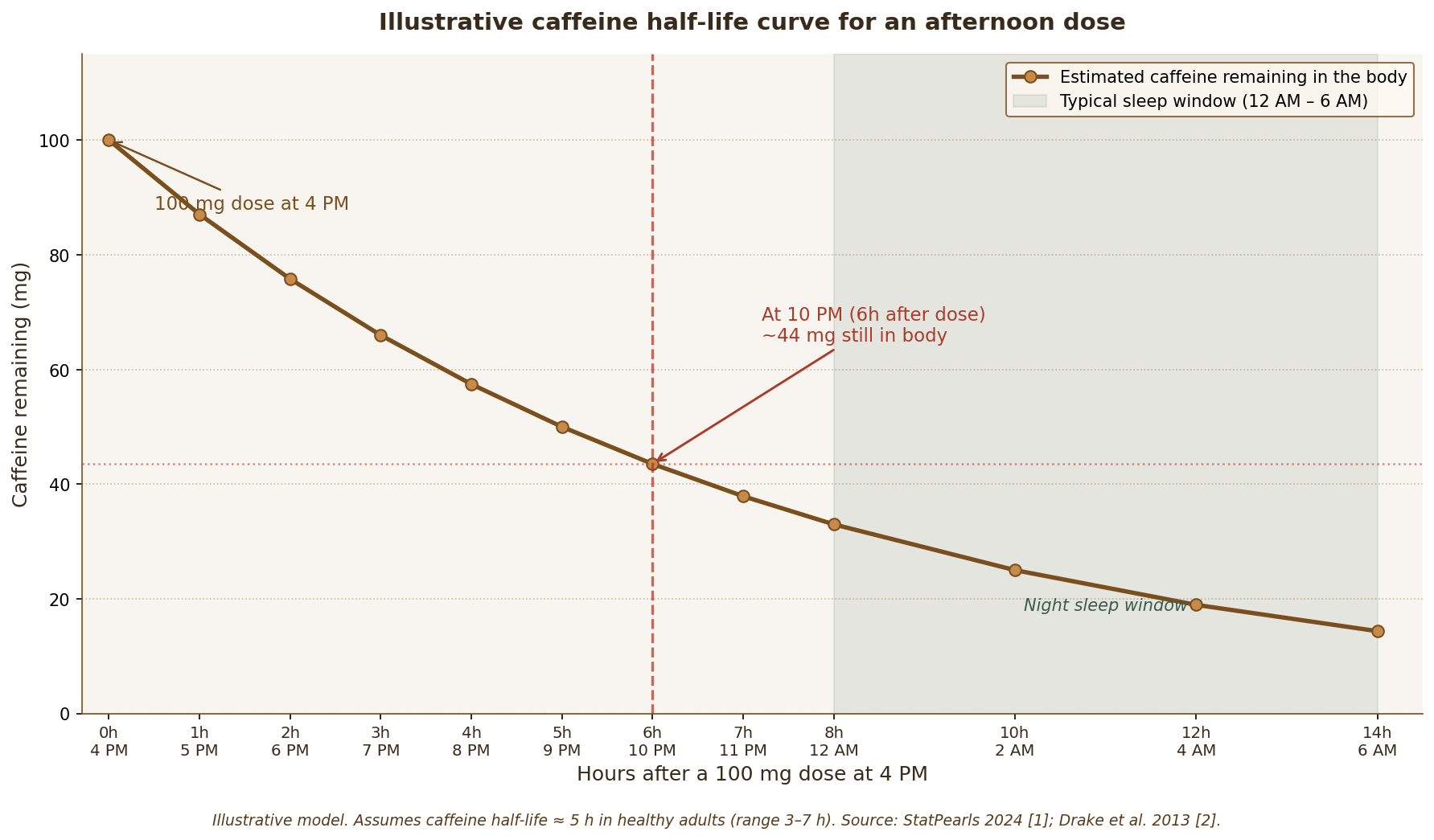
Caffeine from tea is the same molecule found in coffee. It works partly by blocking adenosine receptors, which can reduce the sense of sleep pressure. In healthy adults, caffeine’s half-life is often around five hours, though individual metabolism varies [1].
That makes the arithmetic useful. If a drink supplied 100 mg at 4 p.m. and your half-life were exactly five hours, about 50 mg would remain at 9 p.m. and 25 mg at 2 a.m. That’s an illustration, not a personal blood-level prediction.
A controlled study found that 400 mg of caffeine affected sleep when taken at bedtime, three hours before, and six hours before bedtime [2]. Four hundred milligrams is far more than many ordinary tea cups, so the result doesn’t prove that every afternoon tea will disturb every reader. It does make six hours a sensible starting point for a timing experiment—especially if you already know you’re caffeine-sensitive.
For cup-by-cup ranges, use the caffeine by tea type reference rather than guessing from color alone.
What the evidence can and can’t tell us
The caffeine case is the clearest: dose, timing, and personal metabolism all matter [1][2]. The evidence around bedtime herbs is softer.
Chamomile contains apigenin, a flavonoid discussed in laboratory and review literature for its interaction with benzodiazepine receptors. The same review notes a long history of chamomile use, but that isn’t proof that one tea bag reliably changes sleep [3]. Valerian research is similarly uncertain. A systematic review found signals of improved sleep quality in some studies, yet concluded that the available evidence wasn’t conclusive [4].
L-theanine needs equally careful wording. Tea leaves contain it, but green tea also contains caffeine. A controlled study of L-theanine with caffeine looked at attention and task switching, not an evening sleep promise [5]. A later review discusses several possible tea-and-sleep pathways, but it doesn’t turn a cup of green tea into a sedative [6]. If green tea keeps you alert, move it earlier; don’t assume L-theanine cancels the caffeine.
The practical hierarchy is simple: use caffeine timing as the first lever, ingredient labels as the second, and ritual as the third. Don’t build the routine around an expectation that any herb reliably changes sleep. Our rule for late-day tea is simple: if a cup feels stimulating, move it earlier rather than trying to brew the caffeine out of it.
Use a four-level leaf ladder
“Tea before bed” covers four very different cups:
- Caffeinated leaf tea: Green, black, white, oolong, pu-erh, and matcha all come from Camellia sinensis. Their caffeine levels vary, but none belongs in the caffeine-free bucket. Matcha deserves special care because you drink the powdered leaf; see the matcha caffeine guide and matcha overview for that distinction.
- Lower-caffeine leaf tea: A smaller serving, a lighter brew, or a naturally lighter style may reduce exposure, but “lower” isn’t “none.” Use this level earlier in the evening, not as a late-night loophole.
- Decaf leaf tea: Decaf green or black tea preserves a familiar tea flavor while removing most caffeine. It can still contain a small amount, so check the package and the decaf notes in the caffeine guide.
- Herbal infusion: Plain chamomile, rooibos, peppermint, lavender, and similar botanical infusions don’t contain Camellia sinensis. A pure version is normally caffeine-free, but blends can add tea extract, chocolate, guarana, melatonin, or several herbs. Read the full label.
Start at the lowest level that still feels satisfying. Switching categories is more dependable than trying to outsmart a strong caffeinated tea with a very short steep.
Evening tea options by ingredient profile
The table isn’t a medical ranking. It separates plain herbs, multi-herb blends, valerian-forward choices, and products with added melatonin so you can compare labels before buying.
| Ingredient profile | Options | What to check |
|---|---|---|
| Plain chamomile | Traditional Medicinals Organic Chamomile, 16 bags, Taylors of Harrogate Organic Chamomile, 50 bags, or HANDPICK Organic Chamomile, 100 bags | Pack size, floral intensity, and relevant plant allergies |
| Chamomile blends | Traditional Medicinals Nighty Night combines chamomile and passionflower; Aprika Life Herbal Bedtime Tea lists chamomile, lavender, mint, and hibiscus | Every herb on the label, not only the product name |
| Valerian-forward | Luxmi Estates Valerian Dream is a five-herb blend; Buddha Teas Organic Valerian Root is the simpler single-herb option | Valerian’s earthy flavor and whether the ingredient suits your medication or health context |
| Added melatonin | Celestial Seasonings Sleepytime Plus Melatonin or Twinings Superblends Sleep+ | Consider this a separate supplement choice; check the serving label and ask a clinician when relevant |
Plain chamomile is the easiest baseline because it has one obvious flavor and no stimulant leaf. Lavender-led blends are more aromatic, while valerian can taste earthy. Buy the smallest format first when you don’t know whether you’ll enjoy a herb; ritual fails quickly when the cup feels like a chore.
Brew for consistency, not a caffeine trick
Infusion studies show that preparation variables—including leaf and water amounts, infusion time, and agitation—change how much caffeine moves into the cup [7]. That doesn’t give home brewers a reliable percentage reduction for every leaf. Tea style, particle size, leaf mass, and agitation all change the result.
For an evening green tea that you already tolerate, use three modest controls:
- Measure the leaf instead of adding a freehand mound.
- Follow a lower temperature that suits the tea, using the water-temperature guide as a starting point.
- Make a smaller serving and keep the leaf-to-water ratio repeatable.
If the cup still feels too stimulating, move it earlier or switch to decaf or herbal. Re-steeping, rinsing, or using cooler water can’t certify a cup as caffeine-free.
A practical timing ladder
Use this table as a self-test, not a clinical limit. The six-hour column reflects a conservative starting point informed by caffeine half-life and the high-dose timing study [1][2]. The late herbal window assumes fluids near bedtime don’t wake you.
| Planned bedtime | Trial cutoff for caffeinated tea | Decaf or herbal window |
|---|---|---|
| 9 p.m. | 3 p.m. | Finish around 8–8:30 p.m. |
| 10 p.m. | 4 p.m. | Finish around 9–9:30 p.m. |
| 11 p.m. | 5 p.m. | Finish around 10–10:30 p.m. |
| Midnight | 6 p.m. | Finish around 11–11:30 p.m. |
Run the same cutoff for several evenings before judging it. If sleep still feels delayed, move caffeinated tea one or two hours earlier. If you wake to use the bathroom, keep the tea choice but shrink the cup or finish sooner. Change one variable at a time, or you won’t know which change mattered.
Build a 30-minute bedtime tea ritual
The tea doesn’t need to make a health claim to mark the end of the day. A small, repeatable sequence can separate your last active task from lights-out.
What you’ll need
- One plain herbal or decaf tea whose ingredient list you understand
- A small cup rather than an oversized mug
- A kettle; the Cosori Gooseneck Kettle with Temperature Control is one current-temperature option if you also brew green tea
- A place outside the bedroom to leave your phone
The steps
- 30 minutes before bed: Put the phone on charge away from the chair. Heat only the water you need.
- 25 minutes before bed: Brew according to the package. Don’t double the bags because the word “night” appears on the box.
- 20 minutes before bed: Sit somewhere other than the bed and drink without scrolling. The cup marks the boundary; it isn’t a dose.
- 5 minutes before bed: Finish, rinse the cup, and stop adding fluids.
If you want a breath-based version without sleep claims, the tea and meditation guide offers a short sip-and-breath structure.
Common mistakes and safety boundaries
- Keeping the late oolong and adding chamomile afterward. The second cup doesn’t erase caffeine from the first.
- Assuming “sleep” on the box means caffeine-free. Check for green tea extract, black tea, guarana, chocolate, melatonin, and every listed herb.
- Stacking several new products. One tea, one timing change, and one week of notes is easier to evaluate than tea plus capsules plus gummies.
- Ignoring volume. A huge caffeine-free mug may still interrupt the night because it’s a huge mug.
- Using tea as the only response to persistent sleep trouble. A warm drink is a routine choice, not medical care.
If you’re pregnant, nursing, taking medication, or managing a medical condition, ask a qualified healthcare professional about herbal and melatonin-containing products before use. The same applies when sleep trouble is persistent, severe, or affecting daytime safety.
References
[1] Evans J, Richards JR, Battisti AS. “Caffeine.” StatPearls. Updated 2024. https://www.ncbi.nlm.nih.gov/books/NBK519490/
[2] Drake C, Roehrs T, Shambroom J, Roth T. “Caffeine Effects on Sleep Taken 0, 3, or 6 Hours before Going to Bed.” Journal of Clinical Sleep Medicine. 2013;9(11):1195–1200. https://pubmed.ncbi.nlm.nih.gov/24235903/
[3] Srivastava JK, Shankar E, Gupta S. “Chamomile: A Herbal Medicine of the Past with Bright Future.” Molecular Medicine Reports. 2010;3(6):895–901. https://pmc.ncbi.nlm.nih.gov/articles/PMC2995283/
[4] Bent S, Padula A, Moore D, Patterson M, Mehling W. “Valerian for Sleep: A Systematic Review and Meta-Analysis.” American Journal of Medicine. 2006;119(12):1005–1012. https://doi.org/10.1016/j.amjmed.2006.02.026
[5] Owen GN, Parnell H, De Bruin EA, Rycroft JA. “The Combined Effects of L-Theanine and Caffeine on Cognitive Performance and Mood.” Nutritional Neuroscience. 2008;11(4):193–198. https://pubmed.ncbi.nlm.nih.gov/18681988/
[6] Ouyang J, Peng Y, Gong Y. “New Perspectives on Sleep Regulation by Tea: Harmonizing Pathological Sleep and Energy Balance under Stress.” Foods. 2022;11(23):3930. https://doi.org/10.3390/foods11233930
[7] Astill C, Birch MR, Dacombe C, Humphrey PG, Martin PT. “Factors Affecting the Caffeine and Polyphenol Contents of Black and Green Tea Infusions.” Journal of Agricultural and Food Chemistry. 2001;49(11):5340–5347. https://pubmed.ncbi.nlm.nih.gov/11714326/
The Mind of Tea and Sleep
Tea can’t promise sleep. It can mark the change from day to night. Give caffeinated leaves enough distance from bedtime, choose decaf or a plain herbal infusion later, and keep the cup small enough that comfort doesn’t become a midnight bathroom trip. A useful ritual is quiet, repeatable, and honest about what is in the cup—and about what tea can’t do.